


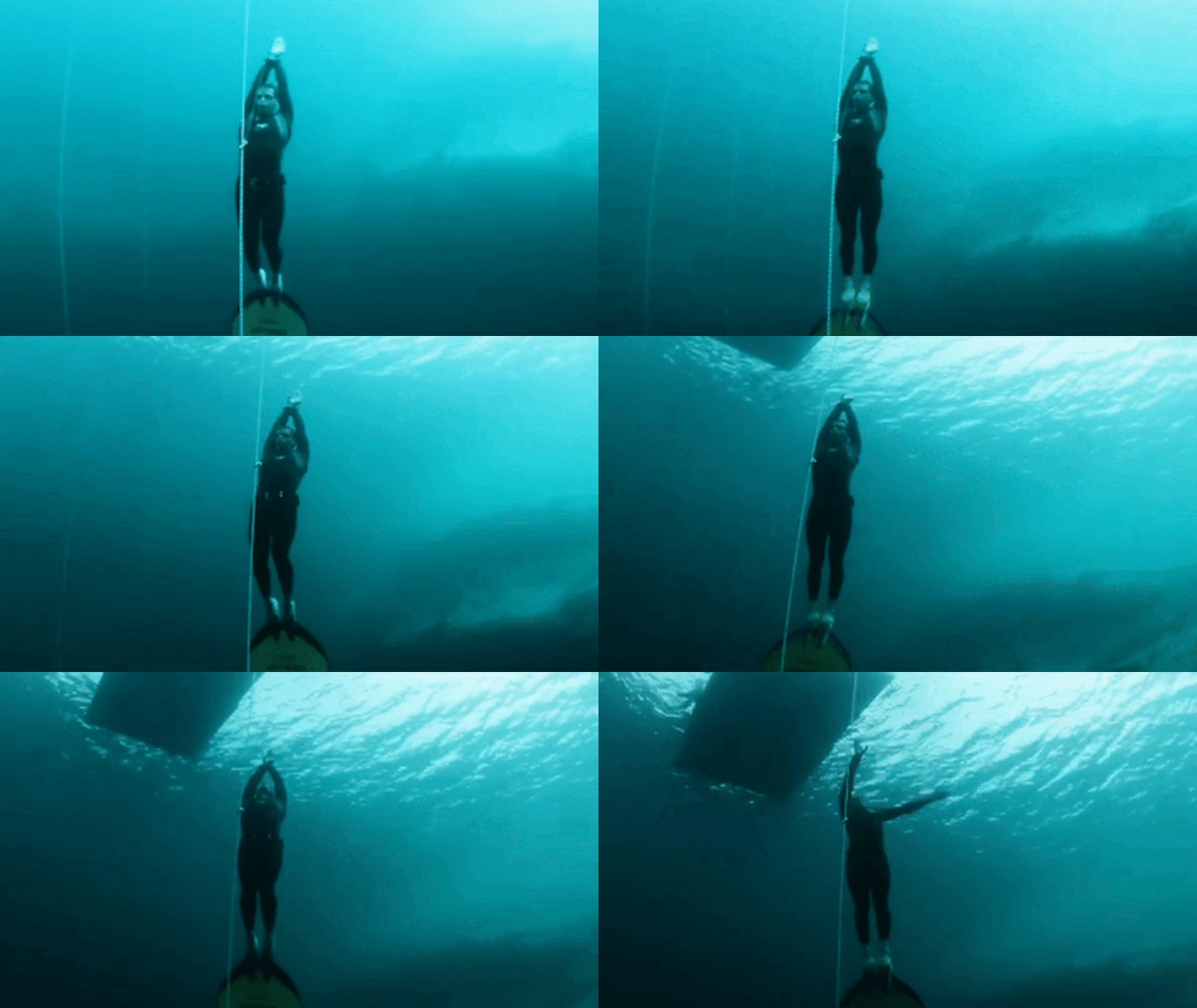
One morning in September 2006, the champion free-diver Anthony “Ant” Williams and a friend, Andy Ross, swam out from the beach in Honaunau Bay, on the west coast of Hawaii, and headed into open ocean. They were in Hawaii to compete in the US National Freediving Championships, an open event that had attracted 60 or so of the world’s best free-divers. Williams, then 33, was ranked in the top 20 in the constant weight division, a category of free-diving that involves competitors swimming as deep as they can while carrying ballast on a single breath of air. “I’d been in the top five a few years before,” he tells me. “A good result in Kona would have improved my world rankings.”
The only problem was the water: it wasn’t deep enough. The two men wanted to get down to 85 metres, perhaps even 100 metres, but the water in the bay only went down to 80 metres. Locals told the men that to go deeper, they would have to swim out past the headland. And so off they set.
“The conditions were perfect,” says Williams. The water was warm and clear, with visibility up to 60 metres. A pod of dolphins followed the men on their way out. The only flotation device they had was a yellow buoy, about 60 centimetres in diameter, coiled on top of which was a long thin rope. At the end of the rope was a kettlebell. “The idea is that you drop the kettlebell into the water to the depth you want to go, then swim down to it, using the rope as a guide.”
After about 20 minutes of swimming, they decided to stop. They were about 500 metres from the headland. “We didn’t realise how exposed we’d be,” Williams says. “We were really out there.” They lifted the weight off the buoy, dropped it into the water, and let it sink to 85 metres. Williams began preparing for his warm-up dive: he would go down to 10 metres and sit there, suspended, holding his breath for four to five minutes. “The idea of the warm-up dive is to switch off and get in a meditative state,” he says. “The calmer you are, the less oxygen you use.” He began what he calls his “breathe-up”, a series of rhythmic inhalations, loading his lungs with more than 10 litres of air. He then swam down 10 metres and, with one hand on the rope, closed his eyes and relaxed. “It was great. My heart rate dropped to the mid-30s. I totally zenned out.”
He’d been down there for about three minutes when he felt a tugging on the rope. He kept his eyes closed and ignored it. “I thought it was some wind above that was lifting the buoy up and down.” Twenty seconds later, the rope tugged again, this time more insistently. Reluctantly, he opened his eyes and saw it – a tiger shark, about four metres long, slowly circling him. “It was the girth that hit me,” Williams says. “It was like a submarine.” But Williams didn’t panic. “Free-diving trains you to stay calm and deal with the situation.” He watched the shark till it swam away, then returned to the surface. There were two charter boats there. “They’d followed the shark,” says Williams. People on board yelled at Williams and Ross to get out of the water. Ross agreed that it was a good idea, but Williams wanted one more dive. “I wasn’t letting a shark interrupt my preparation!” he says. Ross waited in the water while Williams completed his dive. He made it to 85 metres – a personal best.
Such presence of mind verges on the yogic, which is why, when I first heard about Williams, I imagined a swami-like character, burned to teak by the sun, fit, strong and magnetically inscrutable. But when I meet him, at his large modern home in Torquay, Victoria, he looks like he’s off to brunch on a superyacht. He’s wearing a navy-blue Hugo Boss golf shirt and white dress shorts. He’s impeccably polite and wholesomely handsome. But most of all, he is busy. In the past few years, Williams, who is 54, has built a career as a performance psychologist and mental-strength coach, the go-to guy for serious people doing serious things, whether they be paramedics, basejumpers or chief financial officers. “I teach people to perform at their best when it matters most,” he says.
Plenty of people do this work, but Williams, who trained as a psychologist, comes uniquely credentialled. He has held his breath for more than eight minutes, and can swim underwater for 240 metres at a stretch. He has free-dived to a depth of 100 metres, becoming one of only 60 or so people to have done so. And in April 2024, he set a new world record by swimming 182 metres under Arctic ice. (The dive, which took place in Iceland, was filmed by Apple as part of an immersive video series called Adventure.)
“Ant taught himself to face death,” says Lachlan Penfold, director of performance at the Melbourne Storm rugby league team, which contracted Williams to work with their players in the pre-season. “The guys have a natural respect for that, and so his message resonates with them.”

Williams’ work with the Storm mainly involved pool work. “I get them to do breath-holds,” he explains. “Not because I want to teach them to free-dive but because I find that pressure is a combination of three main things – fear, discomfort and uncertainty – and I’ll give you those three things in a breath-hold.” Monitored by instructors, the players would lie on the surface of the pool, face down, and hold their breath for as long as possible. “I say, ‘It’s going to get really uncomfortable, and I want you to spend 10 seconds exploring that discomfort and see where it takes you.’ ”
I tell Williams that this sounds like torture. “The discomfort is just data your mind is sending you.” With training, you can safely push beyond it, he says. “You’re capable of more than you think.”
Free-diving is a sport where the sole purpose is to see who can reach the greatest depth in the ocean on a single breath of air. (There are other disciplines, including dynamic free-diving, which involves swimming underwater for as far as possible on a single breath. That usually takes place in pools.) For people who enjoy breathing, this can be hard to understand. And yet people have free-dived for millennia. The ancient Greeks would dive down to gather sponges or to salvage lost cargo. People have long been diving for pearls or to go spearfishing. The Bajau, or sea nomads, of south-east Asia, are known for diving up to 70 metres deep to harvest shellfish, with little more than a weight belt and homemade goggles. Over thousands of years, they have evolved to have larger spleens, which make more oxygen available in their blood when diving.
Free-diving remained a marginal sport until the release, in 1988, of French director Luc Besson’s film, Le Grand Bleu (The Big Blue). Based loosely on the rivalry between two real-life free-divers, Jacques Mayol and Enzo Maiorca, the film became famous for its depiction of free-diving as a spiritual quest, a search for self-knowledge in the dark vastness of the ocean. (The Big Blue is Williams’ favourite movie; he even named his son, Luc Enzo, after Enzo Maiorca.) Anna Van Nieuwenhuizen, president of the Australian Freediving Association (AFA), says people are drawn to free-diving for all kinds of reasons, “including personal improvement, a love of the ocean and marine life, and by the challenge of pushing their physical and mental limits.” Free-diving is all about breathing and mindfulness, so there is also a crossover from yoga, and from adjacent sports like spearfishing, snorkelling and swimming. (Amber Bourke, Australia’s most successful female free-diver, represented Australia in synchronised swimming as a teenager.) Still, the sport remains niche; the AFA has about 420 members, and there are only a handful of free-diving clubs in Australia.
Most free-divers start early, but Williams didn’t come to the sport until he was 30. Born in Auckland, he was raised, the second of three brothers, by religious parents. The family went to church on Sunday and played choral music at home. “Much of my upbringing was centred on safety,” he says. At high school, he began dating a local girl called Merryn, but “she dumped me after three weeks because I was too boring!” While he admired athletes for their charisma and daring, he was never particularly sporty. (He tried rugby, but it scared him.) Instead, he started surfing. In his upcoming book, Let It Be Tough (Simon & Schuster; out March 31), he writes that, as a “reserved teenager … surfing delivered a life-affirming sense of liberation”.

After school, he attended the University of Otago, where he studied the emerging discipline of sports psychology. “It was such a new field,” he tells me. After graduating, in 1997, he advertised his services in the Yellow Pages. Not long after, he got a call from a man with a gruff Afrikaans accent. “Do you know you’re the only prick in Auckland who does sport psychology?” said the caller. It was Ian McIntosh, former coach of the Springboks, South Africa’s national rugby team. McIntosh was in New Zealand with the South African provincial side, the Natal Sharks, who were due to play the Auckland Blues in three days’ time. But McIntosh’s players had lost belief, and were convinced they were going to lose. He wanted Williams to fix it.
“It was nuts,” Williams says. “I was 24!” Williams threw on the only suit he had – his school formal outfit – and rushed to meet the team in their hotel. McIntosh and the players were waiting for him in the ballroom. When Williams arrived, McIntosh addressed the room. “OK boys,” he shouted. “I’m excited to say I bumped into an old friend of mine, Ant Williams. We used to staff together in Durban. Ant’s a sports psychologist, and he’s f—ing good. He’s going to give us a hand.” McIntosh then called Williams to the stage. As the two men crossed over, McIntosh whispered to Williams: “You’ve got two hours with them.”
In the end, the Sharks lost, but the result – 55 to 36 – was better than expected. More importantly, Williams’ career had begun. His next jobs included working with a cage fighter and a rock climber. Then, in 1999, he was brought on by a New Zealand Grand Prix motorcycle team to work in Europe with their lead rider, a surly young Australian named Mark Willis. Willis had been Australian Rider of the Year in 1996, but his results for the Kiwis had been disappointing. And yet he was reluctant to accept help. “I’m from country NSW,” Willis tells me. “I thought it was admitting defeat if I couldn’t figure out stuff myself.”
At first, Williams tried some conventional strategies, including visualisation, where athletes picture themselves winning, and self-talk, which requires them to actively challenge negative thoughts. Such techniques had proved effective with his other clients, but they didn’t work with Willis. In fact, he got worse. “At one race in Spain, Mark trailed the pack by 30 seconds. He almost got lapped.”
So, Williams changed tack. “Athletes often suffer self-doubt,” he explains. “But it manifests in different ways.” Willis’s self-doubt usually showed up at the first corner of the race, where he would invariably pull back. One afternoon, Willis admitted to Williams that he was afraid that if he went hard into the first curve he would crash, knocking other riders off their bikes. “He’d be humiliated,” Williams says. So Williams made Willis a deal. “I said, ‘Mark, I’m giving you express permission to really throw it into the first corner, and if you crash, I’ll take responsibility.’ ” He even offered to put it in writing. Willis seemed sceptical, but at the next race, in the Netherlands, he dominated the first curve, and turned in his best performance thus far. “It was an insight,” Williams says. “Rather than giving Mark more techniques to try, I took something away. I took away the block.”

Williams worked with Willis for another six months. In July 2000, Willis led his team to victory in the 24-hour Spa-Francorchamps Motos in Belgium, perhaps the world’s most challenging motorcycle endurance race. “Ant was incredible,” Willis says. “He kept me in the zone all the way.” The win was the peak of Williams’ career, but it somehow left him cold. “At first I thought I was just exhausted,” he tells me. “But it didn’t go away.” Then it clicked: he was a fraud. He coached elite sportspeople about pressure and risk, but all his advice had come from textbooks. “I realised that to truly do my job, I had to put my own body on the line.”
Ernest Hemingway said there were only three true sports: mountaineering, motor racing and bullfighting. “The rest are merely games.” But when it came to proving himself, none of Hemingway’s options appealed to Williams. Then one day, his French teacher lent him a DVD of The Big Blue. He watched the movie and took a lesson with a local free-diver. Soon he was hooked. “I loved the sense of weightlessness,” he says. “But there was also that adrenaline.” In 2001, he returned to Auckland, where he started dating his high-school girlfriend, Merryn. (The two married in 2008.) He also began taking part in free-diving competitions. Before long, he’d broken the national record for the deepest dive in a freshwater lake (45 metres) and the longest breath-hold (six minutes and nine seconds).
It’s difficult to picture Williams competing, at least in the traditional sense of trying to beat someone at something. “He’s a very kind, caring person,” says friend, Brendon Brackin. “Not at all an alpha.” But in free-diving, gentleness and calm are optimal traits. “In running, you try to beat the person next to you,” says Danny Hurst, Williams’ dive buddy in Torquay. “In free-diving, you nominate a depth that feels right for you and try to reach that. The real talent is to relax and not compare yourself to others.”

Williams came to embody the paradox of free-diving: he became intensely focused on chilling out. He would rest on a yoga mat in between events and listened to reggae before he dived: its tempo was close to his resting heart rate, and its one-drop rhythm felt floaty and free. “There’s some great Kiwi reggae, so that really worked for me,” he says.
In 2006, he, Merryn, and their newborn son Luc moved from Auckland to Sydney, where Williams had got a job with PricewaterhouseCoopers, coaching its sales team. He increasingly drew his insights from free-diving. “Performing well is about taking positive, calculated risks,” he explains. “To make informed decisions, you need to pause, breathe and stay in control of your emotions.” He was also travelling a lot. “He began to go to events in Turkey and Egypt,” Merryn says. “I kept my mobile phone under my pillow, and I told him, ‘It doesn’t matter what time it is, just text me and let me know you’re OK.’ ”
One of the most challenging aspects of free-diving is hydrostatic pressure. As a diver goes deeper, the weight of the water increases. Even at 10 metres, the pressure has already doubled. At about 30 metres, the pressure triggers a phenomenon known as the mammalian dive reflex. Blood is redirected from your limbs to your vital organs. Your spleen contracts, flooding the body with fresh blood cells. And, to prevent your lungs from collapsing, the capillaries around them fill with plasma and blood, creating a fluid cushion. (This process reverses on the way back up.)
The mammalian dive reflex is thought to be an evolutionary adaptation from billions of years ago, when all life on Earth was aquatic. Still, the pressure at depths below 60 metres is hard to combat. At 100 metres, it’s so intense that the lungs are grapefruit-sized. “I used to come up coughing blood, because my trachea had haemorrhaged,” Williams says. “To get around that, I’d tuck my chin down near my chest.” To prevent his eardrums from rupturing, he would equalise, blowing out while pinching his nostrils (free-divers use nose clips to allow them to equalise while keeping their hands free.) But to equalise deeper than 55 metres, he needed to “charge”, pushing air from his lungs into his nasal cavity and trapping it there by locking his glottis (the mid-part of the larynx). He got so good he could roll the air around, like a ball, at the back of his tongue. Towards the end of his dives, the urge to breathe would become so intense that his chest would convulse, but he trained himself to ignore it. “It’s radical acceptance,” he says. “Over time, with practice, you learn to accept the pain.”
In 2012, he travelled to the Bahamas for Vertical Blue, an invitation-only competition for the world’s best free-divers. There, in a deep, dark abyss known as Dean’s Blue Hole, he dived to 100 metres in the constant weight division. He was only the 23rd person to do so.
Free-diving is an extreme sport. Divers suffer bleeding eyes, busted eardrums, ruptured lungs and neurological symptoms, including tingling, numbness, weakness and even paralysis. They can get swept away by currents or tangled in wrecks and reefs. All top divers, including Williams, have, at some point, lost consciousness. And yet, thanks to myriad safety protocols, only one person, the American diver, Nick Mevoli, has died in competition. (Mevoli, a friend of Williams, suffered a pulmonary oedema at Vertical Blue in 2013, after attempting to reach a depth of 72 metres.) Other high-profile deaths include that of Natalia Molchanova, perhaps the most celebrated free-diver of all time, who disappeared during a recreational dive in Spain, in 2015, and 45-year-old free-diver Andrey Matveenko, who died last November following a training dive in Greece. Amateur free-diving is thought to be much more dangerous, but reliable figures on deaths are impossible to come by.

The cardinal rules of free-diving are: never dive alone and know your limits. “For example, if I’m diving and my vision goes from colour to black and white, I know I’ve got about 15 seconds before I black out,” Williams tells me.
The risks multiply severalfold when ice-diving. For a start, the cold causes your diaphragm and intercostal muscles to tighten, making holding your breath much harder. The logistics also become more complex. When, in 2019, Williams travelled to a frozen lake near Kirkenes, in Norway, to attempt the world’s deepest dive under ice, the temperature was minus 36.5 degrees. The ice on the lake was 1.2 metres thick; it took eight hours to cut a hole in it with a chainsaw. Williams had to abort his first attempt, at 50 metres deep, when the glass on his mask shattered, sending freezing water gushing over his face. He kept his eyes shut – had it touched his eyeballs, the water could have frozen his retinas, necessitating surgery. He made it to 70 metres deep on his second attempt, breaking the world record and fighting narcosis-induced dizziness on his way back up. (Williams’ record was broken in 2021 when Russian world champion Alexey Molchanov got to 81 metres.)
In 2024, he attempted another world record, for swimming the longest distance ever under ice. This time, the attempt was being filmed by Apple. His preparation was short: he only had seven weeks to train, some of which was taken out by a bout of COVID. But come dive day, while dozens of film crew buzzed about on the ice, Williams appears serene. For weeks he had been tuning his psyche, dialling into a parallel frequency. He had visualised the dive, over and over, in forensic detail: he had watched himself from above, succeeding every step of the way. He’d modified his posture and facial expressions to maximise positive neurotransmitters. He countered his doubts with positive affirmations, and successfully reframed his fears. And he practised his breathing, every day, imagining his lungs as two enormous, steel oxygen tanks, sucking in torrents of air, colossal quantities, so much, in fact, that the people around him were struggling to breathe. When his tanks were full, when the lights on the cylinders went from five red bars to green, he mentally screwed the lids shut and felt, growing within his chest, an immense and unstoppable power.
Williams slips into the water and swims soundlessly under the ice, dolphin-kicking through the gelid, milky green gloom, his long sleek body like a ribbon, undulant and utterly at ease. When he pops up at the end, 182 metres from where he started, he’s broken the world record and he’s not even puffing.
After the 2024 dive, Merryn put her foot down. “I told him, ‘I don’t want you to be that guy who doesn’t know when to stop.’ ” Williams consented but then concentrated on his other dangerous pastimes, such as dirt-biking. “He’s a good rider,” says Brendon Brackin. “But we’ve still had plenty of crashes.” The problem with Williams, says another old friend, Karl Adolfsson, who met Williams at PwC, “is that he is a high-level thrill-seeker. He says he’s not, but he is.”
Williams still dives, recreationally, about once a week, usually in the water off Torquay. The day after our interview, he takes me for a lesson. We meet at the local boat ramp, then speed out to sea on Williams’ jetski, to a spot about a kilometre offshore. I am a surfer, and feel comfortable in the waves, but the idea of being dropped in the open ocean induces in me a marrow-level dread. Making matters worse is the weather: it’s grey and drizzling. Even the ocean looks anxious, with lumps of swell jostling confusedly like drunks in a mosh pit. Williams dumps a kettlebell into the water, attached to which is the guide rope. Then we get in the water. I put my face mask on and peer down. It’s a murky, algae-green and clouded with motes: visibility is three metres at best. “This dive is all about you,” Williams tells me. “So I want you to totally relax and concentrate on your breathing.” He pulls on his mask. “I’ll go down first, and you follow me when you’re ready.” Then he disappears.
What follows is a series of dives, each one a little deeper than before. On my first dive, I only get down a few metres before scratching my way back up. On my second dive, I get down to six metres. On the third, I get to 10 metres, but I’m gasping desperately by the time I surface. I panic outright on my next dive, and abort after just a few metres. But on my final dive, I reach a depth of 12 metres. Williams is down there, waiting calmly, like he has all the time in the world. My lungs need air, I’m fighting back panic, and the blood in my skull is pounding. But for one tiny moment I feel a vestige of something amphibious, a flash of knowledge buried aeons deep in my DNA, that understands why I’m here, and is telling me that I’ll be OK. Then I turn, look up at the surface and swim towards the light.
Get the best of Good Weekend delivered to your inbox every Saturday morning. Sign up for our newsletter.
