


On Friday, former Liberal leader Sussan Ley resigned from the parliament. Ley declared: “I welcome the Coalition’s immediate re-adoption of many of [my] directions and policies in recent days and weeks.”
Ley was reaching a little. She referred to the “clear directions” set on “tax, industrial relations, energy, national security and families” – but for the most part, because she had not actually announced much policy, “directions” were all they had ever been.
Labor frontbencher Murray Watt made the point: Ley had “belled the cat” on the fact the leader had changed but policies hadn’t. Labor’s line was predictable but rung true because a similar point was made even before Angus Taylor got the job: what exactly was he offering that Ley hadn’t offered?
The problem goes back further. What did Ley offer, in the end, that Peter Dutton had not offered? And how was Dutton, in turn, different from Scott Morrison? There are personality differences. But on policy we are talking about shadings rather than sharp shifts. This is true even on climate: net zero via uninvented technologies (Morrison), nuclear (Dutton) and opposing net zero (Ley and Taylor) are just variations on how to avoid acting.
Perhaps rapid change will prod Taylor in new directions. The climate is getting worse. AI is advancing. The rules-based international order – as the weekend attack on Iran confirmed – is collapsing. So far, though, Taylor looks a lot like the Coalition giving the traditional approach one more go: “the last roll of the dice for Howard-era Liberalism”, as Herald Sun journalist James Campbell put it.
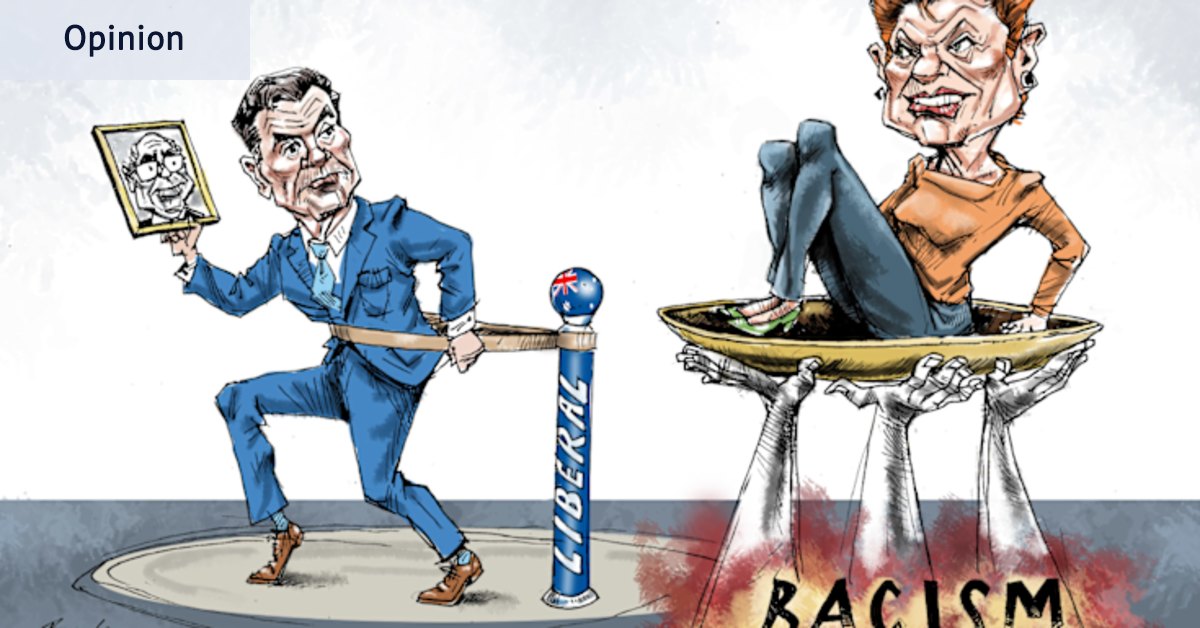
The trouble is that voters have been signalling a desire for something different. At two elections now, Coalition electorates and voters have been willing to shift: to Labor, teals and Greens. Anything-but-the-Liberals is the sense. Which brings us to One Nation’s recent rise.
Yes, this is partly an expression of dissatisfaction with the Coalition. But recall the teal wave of 2022. It took a while, but at some point the political class realised that voters saw not only lack in the Liberals but potential in the teals. That potential lay in their focus on integrity, equality for women, climate change and community. They were beneficiaries of a protest vote – and they were something else, too.
The rise of One Nation is perceived largely as a protest vote – and to some extent it is. A recent SEC Newgate survey found 36 per cent of those saying they will vote for One Nation give one of their reasons as a rejection of the major parties. But that is only part of the story. The same survey found 17 per cent talk about immigration policies; 17 per cent refer to standing up for “Australia’s best interests”; 15 per cent talk generally about the party’s policies. (Respondents could give more than one reason, so the numbers don’t add to 100.)
So a significant proportion are supporting One Nation because they are One Nation. Where that’s not the case, the fact remains: to protest, voters are willing to support One Nation over other options. One Nation’s rise is a symptom of various things. But sometimes it’s important to state the obvious too: people’s willingness to tell pollsters they will vote for One Nation is a symptom of the party’s growing popularity.
That is extremely concerning. One Nation’s calling card has been racism. Its most prominent policy of recent years has been its anti-Muslim stance. You might have predicted its rise, then, by looking at last year’s Scanlon Foundation report on social cohesion, which found more than one-third of Australians had a negative view of Muslims. That was before the Bondi massacre. Another obvious fact that needs restating, then: racism is an important factor in what we are seeing.
How can the Liberals fight this appeal? Last week’s Essential poll revealed an issue on which One Nation voters shared the concerns of other Australians, while Liberal voters departed from the average: “Reducing the gap between the rich and poor.”
Anthony Albanese has been stressing that Pauline Hanson’s record here is in fact bad, pointing to her votes on penalty rates and industrial relations. That is harder for the Coalition to do, because it tends to vote the same way. But what if the Liberal Party found other ways to address inequality? They will never be able to outdo Hanson on migration. They should, however, be able to outdo her with economic answers – and reach parts of the country they are currently failing to reach.
But that would involve conceding that what is needed economically has changed in recent decades. Last week, former Liberal MP Keith Wolahan warned “too many in the Liberal Party still hold on to an image three decades out of date”. Some serving MPs seem to feel the same: last October, Andrew Hastie delivered a strong speech defending centralised planning and decrying his party’s neoliberal eagerness to place its faith in markets. Interestingly, though, Hastie reversed direction last week, telling The Australian that “markets are always superior to centralised control by government”.
Hastie wants to be the next Liberal leader. The interview read like an attempt to reassure colleagues he knew what they wanted – seemingly an embrace of the Howard economic orthodoxy. In other words, exactly what Angus Taylor is promising to serve up. Old habits die very hard.
Also last week, we were told the review of the Liberal Party’s sweeping 2025 election loss will never be released. It will be hard to tell, then, what lessons have been learnt. But we can guess at the answer by asking another question: what has changed in the Liberal approach since 2025 or 2022 – or, in fact, 2007?
Sean Kelly is a regular columnist and a former adviser to Labor prime ministers Julia Gillard and Kevin Rudd.
Cut through the noise of federal politics with news, views and expert analysis. Subscribers can sign up to our weekly Inside Politics newsletter.
 Sean Kelly is author of The Game: A Portrait of Scott Morrison, a regular columnist and a former adviser to Julia Gillard and Kevin Rudd.Connect via X.