


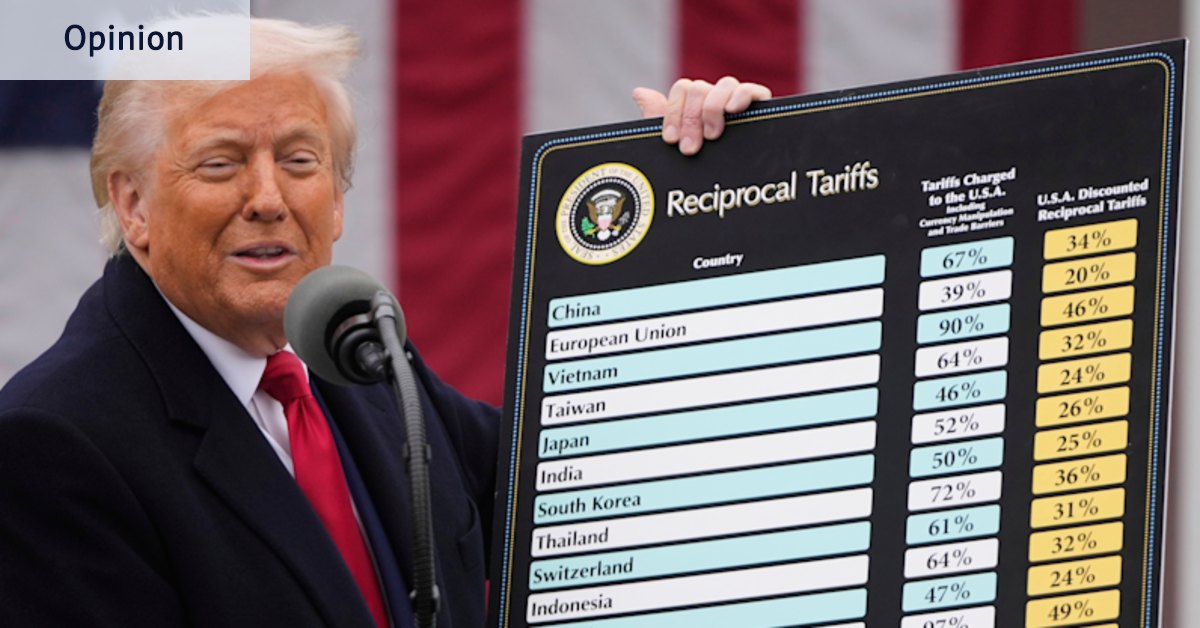
The Trump administration is reportedly considering changes that would lower the effective rate of tariffs on US imports of steel and aluminium. Why would it alter the tariffs if they are being paid for by the exporting countries?
The tariffs of steel and aluminium were among the first that Donald Trump announced, virtually the moment he regained office last year. Initially, the rate was 25 per cent, but within months it was raised to 50 per cent.
The tariffs applied, not just to raw steel and aluminium, but to “derivative” products – the foreign metal content in any imported product – which meant it applied to a percentage of the imported prices of a wide range of consumer goods, including washing machines, ovens, pipes, chains, mattresses, tins used for baking, food and drink cans and bicycles.
Not surprisingly, importers have been complaining about the complexity of the calculations required. Also, as was the case last year when Trump exempted a range of food imports from pre-existing tariffs, the administration has been showing an increased sensitivity to the impact of its tariffs on consumer prices as this year’s midterm elections draw closer.
US Treasury Secretary Scott Bessent confirmed that the administration was considering a “clarification” of the tariffs last Friday, but didn’t expand on that comment.
The steel and aluminium tariffs were imposed under a different and less vulnerable legislative authority than the “reciprocal” tariffs that are being challenged within the US Supreme Court, so any lowering of them would tend to point to heightened concerns about affordability issues. The metals tariffs are insidious, feeding into an extraordinarily wide range of imported goods prices.
While the inclusion of the metals downstream usage does make administration of the tariffs more complex, it wouldn’t be as pressing an issue if it were exporters shouldering the tariffs’ costs and generating the massive revenues Trump continually boasts about.
Despite Trump’s and Bessent’s continuing assertions that the exporters do pay the tariffs (Bessent now says he was mistaken when, before joining the administration, he said tariffs were inflationary) and despite it being an article of faith among the MAGA faithful that it is the case, a series of studies – two of them last week – have contradicted that stance.
The first was a study last month by Germany’s Kiel Institute which, after analysing more than 25 million shipment records covering about $US4 trillion ($5.7 trillion) of imports, concluded that foreign exporters absorbed only about 4 per cent of the tariffs’ costs. It said that trade volumes collapsed as exporters redirected their sales to other markets, but the prices charged by the exporters didn’t fall.
Then, last week, New York Fed economists produced their own analysis, which found that – after Trump (who always chickens out) walked back many of the tariffs he announced on “Liberation Day” last April and exempted some products – the average US rate had increased from 2.6 per cent to 13 per cent at the end of last year.
The analysis of the pass-through of the tariffs concluded, like the Kiel Institute’s, that the bulk of the tariff incidence continued to fall on US companies and consumers.
For the first eight months of the year about 94 per cent of their cost was incurred by US importers, although it said that in the final months of the year that had reduced to 86 per cent.
That might suggest that US importers have renegotiated prices with their suppliers and/or reorganised their supply chains.
It has been notable that exports to the US from China have fallen markedly, but those from Mexico and Vietnam, with lower tariffs, have risen sharply. There may be a significant amount of transshipment, or the re-routing of Chinese products through other jurisdictions, occurring.
The Fed said, given that the average tariff rate in December was 13 per cent, its results implied that import prices for goods covered by the tariffs increased by 11 per cent more than for those goods not subject to the tariffs.
Also last week, the Congressional Budget Office (CBO) opined on the “higher and frequently changing” tariffs put in place last year, saying they would temporarily raise the US inflation rate, reduce real investment, lower the level of real GDP and reduce employment, relative to what would have occurred without them.
It said higher tariffs would directly increase the cost of imported goods and, because many imports are inputs to domestic production (like steel and aluminium), would also indirectly raise costs. American businesses that produced goods that competed with imports would also increase their prices because of the reduced competition.
The CBO’s assessment was that US businesses would absorb 30 per cent of the import price increases by reducing their profit margins, with the other 70 per cent passed through to consumers via increased prices.
Price increases from domestic businesses protected from import competition would fully offset the 30 per cent of price increased absorbed by importing companies, so the net effect of the tariffs, it said, was to raise US consumer prices by 100 per cent of the costs of the tariffs borne domestically, which it estimated to be 95 per cent of their cost.
Those three analyses from authoritative sources, all with similar conclusions, ought to put to bed the debate over who pays for the tariffs.
What they don’t do is explain why, if almost all their cost is ultimately being borne by US consumers, there hasn’t been a more marked impact on the US inflation rate.
Last week’s CPI was surprisingly benign, with the headline number coming in below expectations at 2.4 per cent. In December, headline inflation was 2.7 per cent.
While the core inflation number preferred by the Federal Reserve Board – the personal consumption expenditures index – has been stuck at 3 per cent, the official inflation rate does appear to be subsiding.
Three analyses from authoritative sources, all with similar conclusions, ought to put to bed the debate over who pays for the tariffs.
It might, of course, have been even lower had the tariffs not be raised last year, given that the rate was falling steadily even before Trump retook the White House. Most economists believe the impact of the tariffs on inflation would be – and may well have been – close to a percentage point.
It’s also possible that there is some “noise” in the way the rate has been calculated, given that there are two months of data missing because of last year’s US government shutdown, and also because of the way health insurance costs, which are surging at more than twice the inflation rate, are calculated.
For the inflation data, the Bureau of Labor Statistics uses the retained earnings of health insurers, rather than the premiums paid by consumers, to calculate health insurances’ contribution to the CPI.
Conventionally, countries that raise their tariffs rate experience an appreciation in their currency, which helps blunt the effects on domestic prices by making imports cheaper. That hasn’t happened – the US dollar has fallen 11.4 per cent against the currencies of its major trading partners since Trump’s inauguration – so the full effect of the tariffs should have shown up in the inflation data.
In some respects it has, as goods and food inflation rates are higher than the overall numbers. But the relatively modest exposure of the US to imports – its proportion of global imports is in the low double digits – and Trump’s repeated walking back of his announced rates, the absorption of much of the initial price impacts through a pre-tariffs build up of US companies’ inventories and, perhaps, a lower pre-tariff underlying rate of inflation might explain why they haven’t (yet?) been more visible within the CPI data.
The Business Briefing newsletter delivers major stories, exclusive coverage and expert opinion. Sign up to get it every weekday morning.
 Stephen Bartholomeusz is one of Australia’s most respected business journalists. He was most recently co-founder and associate editor of the Business Spectator website and an associate editor and senior columnist at The Australian.Connect via email.