


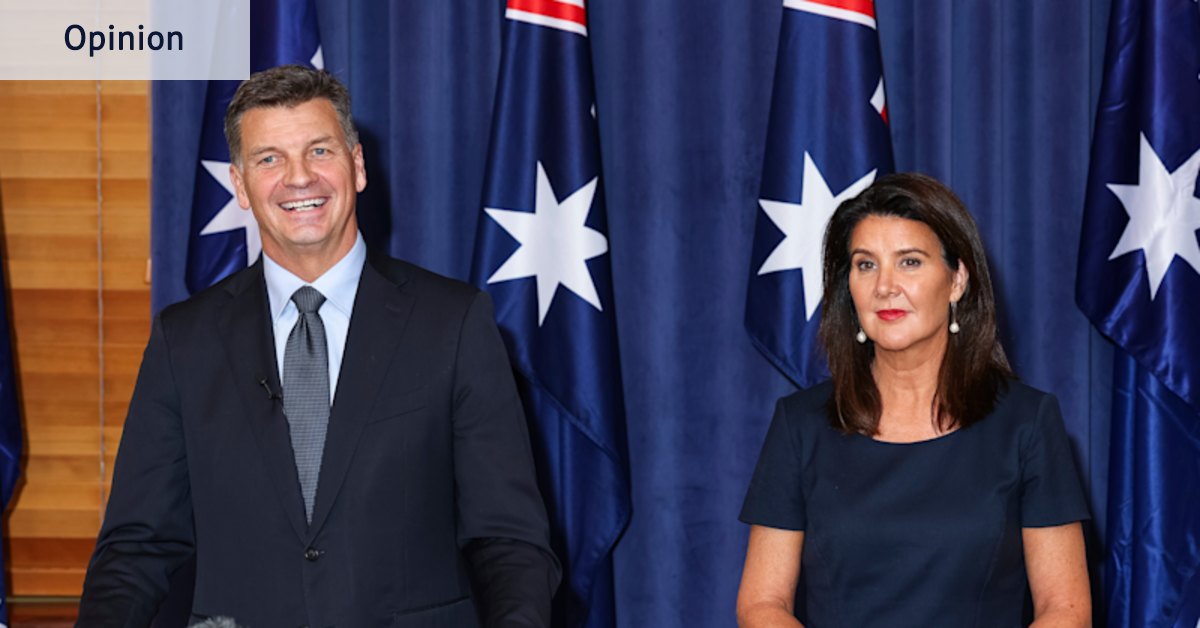
There are three elements that help determine whether an opposition leader will succeed. Angus Taylor, the newly elected leader of the Liberals, probably won’t need all three. Sometimes, just one is enough. Still, at this early stage, there are signs that Taylor may not have any.
The first is luck, also known as timing. Are you taking over at a time when the government is advantaged or disadvantaged by external events? Here, first impressions can be misleading. In Anthony Albanese’s first term, inflation seemed to dominate, a clear obstacle for the government. But in the end, other events – Donald Trump’s tariff war and his meeting with Volodymyr Zelensky – gave Labor a huge boost.
The second element is about your personal ability to command attention. It’s hard to comprehend just how hard this can be from opposition. Little of what you do has any impact – it’s all hypothetical. So how do you get the public to give you their time?
There are two main aspects here. One is political charisma. Bob Hawke is the exemplar, but it’s a stranger quality than his success suggests: it is a little like “star quality”, which can turn shy people into movie stars. Kevin Rudd was, on the face of it, a completely different proposition from Hawke. And yet Rudd, like Hawke, had some ineffable ability to reach voters through the camera.
This is a type of genius; and like all genius, it’s impossible to copy. This is unfortunate for Taylor, who does not possess it. In his first press conference as leader, Taylor improved when it was time for questions. In his prepared remarks, he appeared oddly low-energy, which is closer to his usual mode.
This is shallow stuff, so it is fortunate for all of us that personality and performance are not the only way to reach voters. Opposition is about making something out of nothing: turning particular policies into national issues. In his first term as opposition leader, Bill Shorten was skilled at this, destroying Joe Hockey’s “lifters and leaners” budget in 2014 and dictating much of the political agenda, much as Kevin Rudd had in 2007.
There are often pointers to the existence of this skill before a politician becomes leader. Rudd was a dynamo as shadow foreign affairs minister, particularly on the wheat-for-weapons scandal. As a minister, Shorten made the NDIS into a national cause. Taylor has not had any policy wins that anyone can remember.
That said, neither Anthony Albanese nor John Howard, as opposition leaders, were attention magnets. Both, however, understood the third element perfectly.
In 2024, this final element was explained by my former colleague, Lachlan Harris, who worked closely with Rudd on his successful campaign: “It usually takes several election losses for oppositions to learn that it’s often the things you don’t do that matter the most. The policies you don’t launch. The fights you don’t pick. The party shibboleths you don’t pursue. Opposition leaders must show restraint and restrain their party to prove they are ready to govern.
There are conflicting signals here from Taylor. On Friday, he emphasised two issues: “standard of living” and “protecting our way of life”. At the level of discipline, this is textbook – in Harris’ formula, “seeking to channel the voting public’s attention into a small number of carefully curated political fault lines”.
And yet on both topics, there are already doubts around whether Taylor can narrow them to issues on which most voters will be onside. “Senior sources” told The Australian before the leadership vote that Taylor “had been talking to colleagues about the party being full-throated on cultural issues like the primacy of the Australian national flag and caution on the overuse of Welcome to Country”. And indeed yesterday, speaking about immigration, Taylor said he wanted people “who are happy and proud to stand in front of the Australian flag”.
These are exactly the types of issues that helped paint Peter Dutton as a cultural warrior rather than an economic manager. Taylor’s repeated assertion that in immigration “standards have been too low” treads on similarly dangerous ground – especially when you add it to Jane Hume’s election reference to “Chinese spies” and Jacinta Nampijinpa Price’s comments about Indian migrants.
And here we come back to the question of timing.
Does Taylor understand contemporary Australia – a country in which almost one in three residents were born overseas? The same question arises with indications the Liberals will oppose any changes to the capital gains tax on property. This might work: opposing tax rises often does. But at this particular time in Australia, is standing against any measure with a chance of bringing down house prices a good idea? Or is this one of those fights you have to learn not to pick?
The final issue of timing is the most crucial.
It is likely the Coalition will get some poll boost from its new leadership. Some caution should be exercised here. As commentator Bernard Keane has pointed out, some of this will be the return of men who were unable to stomach a woman as leader. This leads into a crucial issue. There is a distinction between a section of the Coalition’s base returning and poll numbers that reflect a genuinely viable party of government.
This clash was illustrated by Sunday’s news that Charlotte Mortlock, founder and director of an organisation to promote women in the Liberal Party, had left both the organisation and the party. Is it still possible both to appeal to the party’s base and reach a wider group of voters? To win back both the voters who have left it for One Nation and voters who have left it for the teals? This is the problem Taylor’s ascent does not solve, at least not automatically. What if John Howard’s “broad church” simply makes no sense any more?
It is a big ask for Angus Taylor: to surprise us all, showing qualities as leader we have not yet glimpsed. But can the Liberal Party surprise us too, at this precarious moment in its history? That is an even bigger question.
Sean Kelly is author of The Game: A Portrait of Scott Morrison, a regular columnist and a former adviser to prime ministers Julia Gillard and Kevin Rudd.
Get a weekly wrap of views that will challenge, champion and inform your own. Sign up for our Opinion newsletter.
 Sean Kelly is author of The Game: A Portrait of Scott Morrison, a regular columnist and a former adviser to Julia Gillard and Kevin Rudd.Connect via X.