


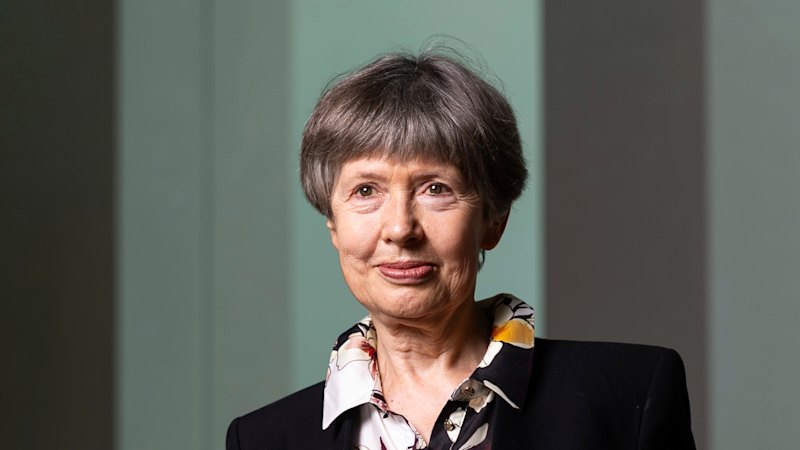
The Polish-born professor, physicist and air-quality expert, 73, was named one of the 100 Most Influential People of 2021 by Time magazine.

Each week, Benjamin Law asks public figures to discuss the subjects we’re told to keep private by getting them to roll a die. The numbers they land on are the topics they’re given. This week, he talks to Polish-born professor, physicist and air-quality expert Lidia Morawska. The 73-year-old was named one of the 100 Most Influential People of 2021 by Time magazine.
DEATH
Two weeks before you left Poland for Canada in the 1980s, you received news that your husband, Jan, had cancer. He eventually went into remission but, later, as you were leaving Canada for Australia in the 1990s, the cancer returned – and Jan passed away just over a year after arriving in Brisbane. Your children were 15 and 10. How did you navigate such a devastating loss? It definitely was very difficult. When we arrived in Brisbane [to take up a position at Queensland University of Technology], it was also a new country: new schools, new system, new position. But when you have a challenge, you deal with the challenge.
How old was Jan when he died? He was 39. He would have been 40 in November, the month after he died.
So young. And how old were you? He was a month younger than me.
Did anything help? All of our family was in Poland, so I was, in a way, completely alone. To be honest, I didn’t want anyone to know. If people know that you have a very big personal problem, you are treated a bit differently. Did I want to be treated differently? I didn’t. So it was only really in the last week, when it was very clear that it was the end and I couldn’t come to work, that I talked to the people at QUT. It was a very welcoming group of colleagues, so I felt immediately like I was among friends.
You’ve achieved so much: winning the David Sinclair Award [for excellence in aerosol science]; being listed as one of the Most Influential People in the world by Time magazine; winning a Prime Minister’s Prize for Science last year. Can you die happy? I don’t know. I certainly don’t have the feeling that I achieved everything that can be achieved in my area. We’re still in a not much different situation now than we were at the beginning of the pandemic in relation to indoor air quality. So this is the purpose now: to influence change.
SEX
Many scientific disciplines have been, historically, male-dominated. What was it like for you, as a woman, rising through the ranks in physics? I must say that for quite some time – maybe even until we were in Canada – I never thought about any issues around being a woman. I think the reason for this was that both my parents were educated. My mum had a degree in chemistry; my father had a degree in electrical engineering. There was that feeling that I could achieve whatever I wanted. But, in Canada, a mother of one of my daughter’s friends asked me, “Oh, how come you chose such a non-feminine topic?” I remember so vividly thinking, “What a silly question!”
What were the big social differences you noticed between Poland, Canada and Australia when it came to sex, relationships and romance? I don’t know whether these were topics of my conversations – maybe because when I left Poland, I already had family. At the same time, Poland is a very Catholic country, which is, of course, different to Canada and Australia. But still, there was a very liberal approach. I didn’t notice any major differences.
What do you find interesting and sexy about science? How do we make STEM disciplines appealing to young people? Well, everyone’s different and certain people are better at certain things. For example, as much as I love music or I love art, I cannot play instruments. It was very clear, at a young age, that I can listen, but I can’t make music. If we were all good at the same things, I guess the world would be very boring! But the other aspect is about making all these choices available to kids at a young age. And I had all those choices. It’s not about making things sexy: it’s about making them available.
POLITICS
You want to mandate good indoor air quality in Australia. To do that, though, you need to work with policy-makers. How are you finding the task? The biggest problem is that there is not just one government body responsible for this. If we are talking about outdoor air, it’s very clear: there’s one body in every state. But in relation to indoor air quality, there are residential buildings and public buildings. Mandating quality in residential buildings is pretty much impossible. And each type of public building belongs to a different government portfolio. So starting this conversation is very difficult.
What’s been your experience of engaging with politicians? It’s extremely frustrating. It’s obvious that this is a very basic thing we need and it isn’t being done. But it’s not simply the fault of politicians who don’t listen: it’s a much more complex problem. If people don’t realise there are problems with air quality or pollution, they don’t put pressure on politicians to effect change.
‘It’s extremely frustrating. It’s obvious that this is a very basic thing we need and it isn’t being done.’
Professor Lidia Morawska
Does winning a Prime Minister’s Prize for Science help? I hope so!
What do you think constitutes good leadership? You have to have a vision. On the other hand, a good leader must also listen and not assume that what they think is the right direction is how something must be done. In particular, listen to those who have opposing views. Sometimes – as much as it might sound like complete nonsense – when you get to the bottom of what they’re saying, you start to see their point. And that point may require you to modify how you address things.
Many people look up to you, Lidia. Have you ever considered running for political office? Definitely not. Again, it’s about knowing what you are good at!
