



Updated ,first published
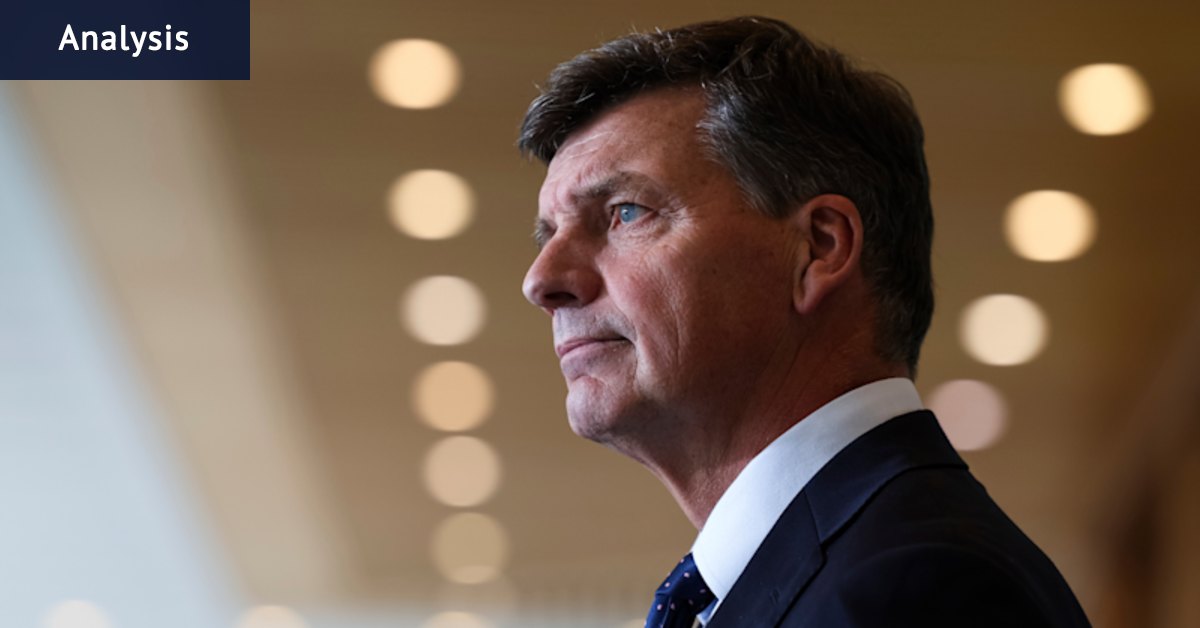
Liberal Party leadership challenger Angus Taylor is a conventional Liberal at a time when unconventional ideas are taking root in centre-right parties around the world.
Taylor resigned from Opposition Leader Sussan Ley’s frontbench at 7.30pm on Wednesday, setting up a spill of the party’s leadership.
The 59-year-old has an extensive pre-politics resumé: the son of a fourth-generation NSW sheep farmer, he was a boarder at Sydney’s elite King’s College who parlayed law and economics degrees from Sydney University into a Rhodes scholarship to Oxford.
He had a successful consulting career at McKinsey and Co and Port Jackson Partners before he was elected to parliament as the member for Hume in Tony Abbott’s 2013 landslide election win.
On paper, Taylor looks like the Liberal leader from central casting, the complete package. But some in his party room question whether he is ready to lead, and his record for developing and landing policies is not dazzling. He may also be too cautious for the toughest job in parliament – leader of the opposition.
The biggest gamble in his political career was leaving his mansion in Sydney’s eastern suburbs in 2011 and moving to Goulburn with his wife, high-profile barrister Louise Clegg, and their four children – Hamish, Olivia, Adelaide and Richard – when it became clear that former Hume MP Alby Schultz was about to retire. At the next federal election, two years later, Taylor became the local member.
Former prime minister Abbott, a mentor for many years, remains close to Taylor. Taylor is a member of the Liberal Party’s conservative factional grouping, and during the last Coalition government worked in several portfolios.
These included being assistant to the prime minister, minister for cybersecurity and law enforcement and a stint as the Scott Morrison-era minister for energy and emissions reductions, a politically fraught job steering the Coalition government’s climate policies.
Taylor has kept quiet during the ructions that have plagued Sussan Ley’s leadership, but his second tilt at the Liberal Party’s top job has been a source of speculation since she beat him 29 to 25 in the party room ballot just after the punishing 2025 election defeat.
Taylor is closer than he was in May to getting his hands on the prize he has long sought, at the same time as Liberal orthodoxies such as less government spending and government intervention are being challenged by populists.
One example was Andrew Hastie, himself a contender for the leadership until a few weeks ago, calling for the government to consider supporting the revival of the car industry; it’s hard to see an economic dry like Taylor endorsing that policy.
Taylor is a classical Liberal, a conservative who believes in free markets, the primacy of the traditional family unit, and a link back to the party’s glory days of John Howard’s long reign.
If he becomes the party’s leader, Taylor will have to manage the competing demands of a new generation of Liberals, such as Hastie, who want the opposition to take policy risks and tackle culture wars with more economically orthodox members of the party, who are desperate to reassert their claim as better economic managers than Labor.
The Liberal Party traditionally had a lock on that title, even in opposition. It has hurt the Coalition to see Jim Chalmers hand down two budget surpluses while also delivering tax cuts that Dutton’s opposition, with Taylor as the shadow treasurer, did not match.
His period as shadow treasurer under Dutton is not regarded as a success. Taylor struggled to land a blow on Chalmers, even as the Reserve Bank raised interest rates 12 times during Labor’s first term to reduce persistently high inflation.
Taylor released little in the way of policy while he was shadow treasurer, but his supporters argue he was hamstrung by the former opposition leader, who was focused on criticising the government and keeping the spotlight off the opposition’s threadbare policy offering.
Taylor has taken 13 years to climb the ladder and be within a rung of the Liberal Party leadership.
If he is given that responsibility, it will come with the opportunity for the party to reset, re-engage and perhaps even reposition on a handful of policy areas.
That opportunity would also bring risks. As the official leader of the opposition, Taylor would be under more scrutiny from day one than he ever experienced as a minister or shadow treasurer, and millions of Australians who have never heard of him will begin to form their judgments. He has only one chance to make a first impression.
After a successful challenge, Taylor would be smart to move quickly on a substantial piece of policy – tax, housing or immigration, for example – to mark a clear break with Ley to give his party something meaty to talk about.
Even if everything were to go perfectly for him from day one – and history would suggest that’s unlikely – an opposition he leads would face an enormous task against Prime Minister Anthony Albanese and his whopping 94 seats in parliament.
The member for Hume is not a natural risk-taker, but he would need to take at least one or two.
Cut through the noise of federal politics with news, views and expert analysis. Subscribers can sign up to our weekly Inside Politics newsletter.
 James Massola is chief political commentator. He was previously national affairs editor and South-East Asia correspondent. He has won Quill and Kennedy awards and been a Walkley finalist. Connect securely on Signal @jamesmassola.01Connect via X or email.