


Three decades later, the former dishwasher commands the most valuable company on Earth. More than 96 per cent of Huang’s fortune has been accumulated since 2020, when the artificial intelligence revolution transformed Nvidia’s graphics processing chips into the indispensable hardware powering everything from ChatGPT to autonomous vehicles.
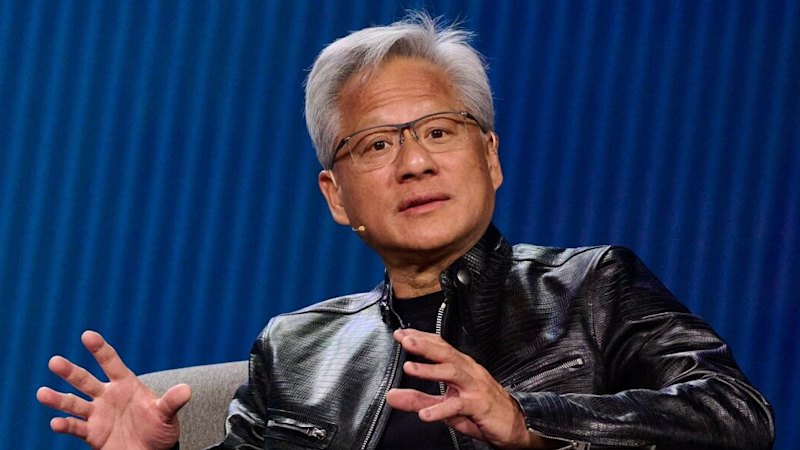
On Tuesday afternoon in Las Vegas, wearing his signature Tom Ford leather jacket – this one in crocodile-scale pattern – Huang held court for nearly two hours, fielding media questions on everything from China export controls to the future of gaming graphics. He commands the room with the energy of a man half his age, speaking without notes and pivoting seamlessly between dense technical specifications and philosophical tangents about the nature of intelligence.
Loading
The Vera Rubin announcement was the headline act. Named for the American astronomer who revolutionised the understanding of galaxy motion, the new platform promises tenfold improvements in AI training efficiency over its predecessor, Blackwell. A 10 trillion-parameter model can now be trained in one month using one-quarter of the chips, Huang claimed.
“Demand for Nvidia GPUs is skyrocketing,” Huang said. “Models are increasing by a factor of 10, an order of magnitude, every single year.”
Yet the announcement came amid mounting competitive pressures. Advanced Micro Devices is gaining ground with big customers including OpenAI and Oracle. Tech giants Google, Amazon and Microsoft are designing their own chips through partnerships with Broadcom, whose market value has soared past $US1.6 trillion on the back of the custom silicon boom.
Nvidia’s stock is down 8 per cent from its October peak, having shed some $US460 billion in market value. Wall Street analysts remain overwhelmingly bullish – 76 of 82 rate it a ‘buy’ – but the path forward is narrower than the stratospheric gains of 2023 and 2024 suggested.

Nvidia founder Jensen Huang as he introduced the Vera Rubin AI super computing platform during a news conference. Credit: AP
Huang appears unfazed. His company, he noted, employs just 40,000 people – “the smallest large company in the world” – with turnover so low that many staff members stay for 20 to 25 years.
“We have supply chain partners and collaboration partners all over the world who are counting on us to do our part,” Huang said. “There’s a great responsibility that comes with our company.”
For now, that responsibility rests squarely on the shoulders of a man who still checks his email from 4am daily, including holidays, and who has previously suggested he intends to lead the company for “another 30 to 40 years”.
Whether the market – or Huang’s own mortality – will permit that remains an open question.
David Swan travelled to Las Vegas with support from Samsung, LG, Hisense and Lego.
The Business Briefing newsletter delivers major stories, exclusive coverage and expert opinion. Sign up to get it every weekday morning.
