


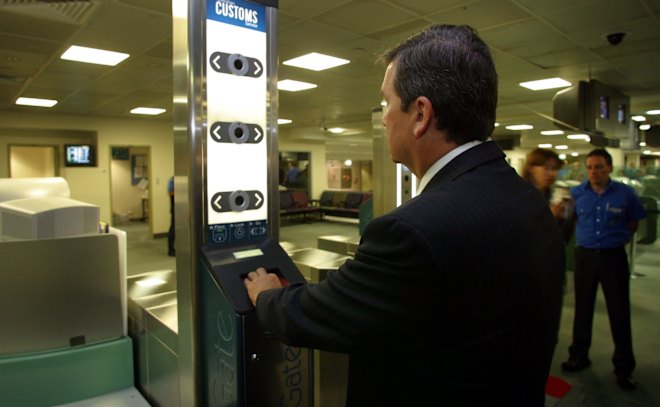
While Australia relies on the printed customs declaration cards and kiosks that process physical passports, electronic travel authority documents as well as biometric scanning in places such as Singapore and Doha make the arrivals process seamless, and comparatively painless.
Brisbane Airport chief Gert-Jan de Graaff said: “We must do all we can to make travelling to Australia as smooth as possible. Modernising and digitising the border is an essential part of that.”

Brisbane is to host the 2032 Olympics.Credit: Courtney Kruk
Australia has driven past innovations around aviation and border control; it was among the first to implement advanced passenger processing, which checks the visa validity before a passenger is allowed to board for Australia, following the September 11, 2001, attacks.
Evolving beyond the current kiosk system, which launched in 2007, has proved difficult. Speaking at the Australian Airports Association national conference on the Gold Coast last week, Sydney Airport chief Scott Charlton revealed that after buying 40 more kiosks to expedite the arrivals process in Sydney, only eight had been successfully installed.
Griffith Institute for Tourism fellow Justin Wastnage said politicians’ travel patterns were not the culprit for Australia’s border woes.
A much larger issue was “institutional misalignment” between the various agencies overseeing the border, which include the Australian Border Force and the Department of Agriculture, Fisheries and Forestry, Wastnage said.

Melbourne Airport CEO Lorie Argus speaking at the Australian Airports Association National Conference, said there were many examples overseas of more seamless passenger arrivals systems.Credit: The Age
Those agencies lacked a “joined-up approach” to reforming the current two-step process under which arriving international passengers present their physical passport as well as fill out a customs form, he said.
As for politicians, “It’s not a lack of awareness; it’s a lack of importance. Because there are no votes tied to it,” he said.
“If you’re looking at a cost-of-living crisis, and you’re looking at people who cannot afford to buy homes, and then you’re looking at streamlining the border, what’s going to get more attention?”
Post-pandemic growth in international travel shows little sign of slowing, with the compound annual growth rate of passenger traffic to Australia rising at 2.1 per cent, according to the Airports Council International.
In the year to August, international in-bound passengers rose almost 10 per cent to 1.81 million from 1.65 million, according to the Bureau of Infrastructure and Transport Research Economics.
For this reason, Melbourne Airport’s Argus said she did not want to be welcoming the Olympics to Brisbane with paper arrivals cards “for the rest of the world to see”.
Argus said she was routinely sent images from 3AW’s Jacqui Felgate reminding her [Argus] “how terrible my international arrivals experience is”.
Border Force is trialling a digital incoming passenger card that is embedded in the Qantas app on flights between Brisbane and New Zealand. The program, which replaces the physical card, began last year.
Border Force says it is committed to border modernisation and building on automation that has been in operation for almost 20 years.
It says one of the primary drivers is the digital incoming passenger card, which it calls “the foundation of our future model”.
Argus said the digital arrivals card had been proved to work in many places, including New Zealand and Bali.
Brisbane Airport’s de Graaff said: “We’re huge advocates at Brisbane Airport for modernising the border and creating a more seamless passenger journey”, which was why the airport was at the forefront of the digital arrivals card pilot program, as a first step ahead of the Olympics.
Loading
Looming deadlines around Olympic Games have forced innovation on airports in the past. The ability to check-in passengers from any airline at any desk, for instance, was a capability first rolled out before the 1984 Los Angeles Olympics.
The Business Briefing newsletter delivers major stories, exclusive coverage and expert opinion. Sign up to get it every weekday morning.
