


Tracking their peers’ losses on Wall Street, Australian tech stocks stumbled, with software firms WiseTech Global and Technology One down 1.4 per cent and 2.1 per cent, respectively, while AI data centre operator NextDC lost 4.9 per cent and family member search app Life360 fell 4.4 per cent. Meanwhile, data centre and warehouse owner Goodman Group led the property sector lower with a 3.4 per cent fall.
The prospect of higher borrowing costs for longer weighed on discretionary retailers, sending Officeworks and Bunnings owner Wesfarmers down 1.7 per cent, while electronics chain JB Hi-Fi lost 0.8 per cent. More defensive stocks such as supermarket owners Woolworths (up 0.2 per cent), Coles (up 0.8 per cent) and Telstra (up 1.5 per cent) fared better.
Loading
Most large financial stocks fared better, limiting the market’s overall fall as the sector accounts for about a third of the ASX. CBA – the nation’s biggest lender — rose 1.3 per cent, National Australia Bank rose 1.7 per cent and ANZ Bank was flat. Westpac shares lost 0.5 per cent.
Shares of Medibank Private rose 1.2 per cent after the health insurance giant said it will buy Better Medical, a network of 61 GP and medical clinics in Victoria, Queensland, South Australia and Tasmania from private equity firm Livingbridge for about $159 million.
The Australian dollar was trading at US64.90¢ on Wednesday afternoon.
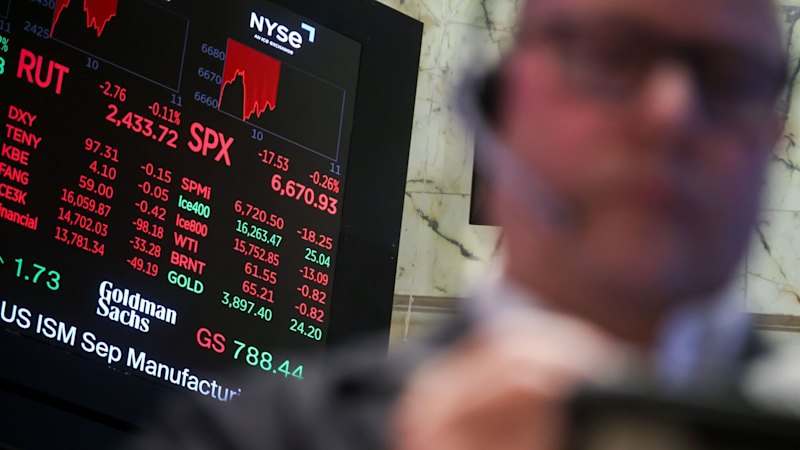
The market decline on the ASX followed a sell-off on Wall Street overnight on concerns valuations may have run too high.
A chorus of Wall Street executives has been warning investors to brace for a pullback. News that Michael Burry, the trader depicted in the movie The Big Short who famously bet on a US housing market crash in the run-up to the 2007 crisis, has wagered $US1.1 billion ($1.69 billion) on share price falls for AI chipmaker Nvidia and software company Palantir didn’t help sentiment.
The S&P 500 fell 1.1 per cent overnight, pulled lower by the tech giants that had been driving its recent rally. The Dow Jones Industrial Average fell 0.5 per cent, and the Nasdaq composite sank 2 per cent.
Loading
At a time when traders have started questioning the need for a breather, the chiefs of giants from Capital Group to Goldman Sachs and Morgan Stanley noted the possibility of a pullback as a healthy development. Not only are sentiment and technical indicators flashing signs of overheating, but the narrow leadership of big tech has made some investors uncomfortable.
“Tough to argue against that,” said Elias Haddad at Brown Brothers Harriman & Co. “While the stock market rally is not irrational (backed by solid company earnings and easier monetary policy), it does reflect a degree of exuberance judging by elevated investor bullishness and options market positioning.”
Palantir Technologies, which had more than doubled so far this year, slumped 8 per cent despite reporting results that beat analysts’ forecasts.
Nvidia also reversed course from a day earlier, falling 4 per cent, while Microsoft dropped 0.5 per cent. Their huge values give them outsize influence over the US market’s broader direction.
Bucking the trend, Apple shares rose 0.4 per cent after a report that the tech giant is preparing to enter the low-cost laptop market for the first time, developing a budget Mac aimed at luring away customers from Chromebooks and entry-level Windows PCs.
Wall Street remains focused on corporate earnings. Roughly three out of every four companies within the S&P 500 have reported their latest results, which have been mostly better than analysts expected.
with AP, Bloomberg, AAP
The Business Briefing newsletter delivers major stories, exclusive coverage and expert opinion. Sign up to get it every weekday morning.
