


It’s hard work trying to be nuanced in a media landscape thirsty for binaries. Anwar could have easily deflected; Malaysia counts on China for trade, too.
Earlier, Albanese met Philippines President Ferdinand Marcos Jr, who deals almost weekly with serious on-water incidents of Chinese heavy-handedness in what the Filipinos call the West Philippine Sea.

Anthony Albanese speaks with Singaporean Prime Minister Lawrence Wong, left, and Singaporean Foreign Minister Vivian Balakrishnan on the ASEAN sidelines on Tuesday.Credit: AP
“The Philippines is grateful [Australia] always stands shoulder to shoulder with the Philippines in the face of some of the challenges, the common challenges, that we have to deal with in our region,” Marcos said, before the meeting went behind closed doors.
Australia signed a lengthy statement with all 11 ASEAN members warning of “intensifying geostrategic shifts … heightening the risk of conflict”, and that noted “peace and stability of our region are our collective responsibility”.
China has not yet filled the vacuum created by Trump’s America First rhetoric and actions.
Aside from this heavy topic, Albanese’s press conference with host Anwar seemed genuinely warm. The pair had just announced a billion-dollar investment by Monash University for a new campus in Kuala Lumpur. But Anwar was also in a generally chipper mood, having finally concluded his one-year stint as the rotating ASEAN chair.

Anthony Albanese, left, speaks at the Malaysia-Australia annual leaders meeting on the sidelines of ASEAN on Tuesday.Credit: AP
He opened the ASEAN closing ceremony, shortly before meeting Albanese, saying: “Oh, what a relief.”
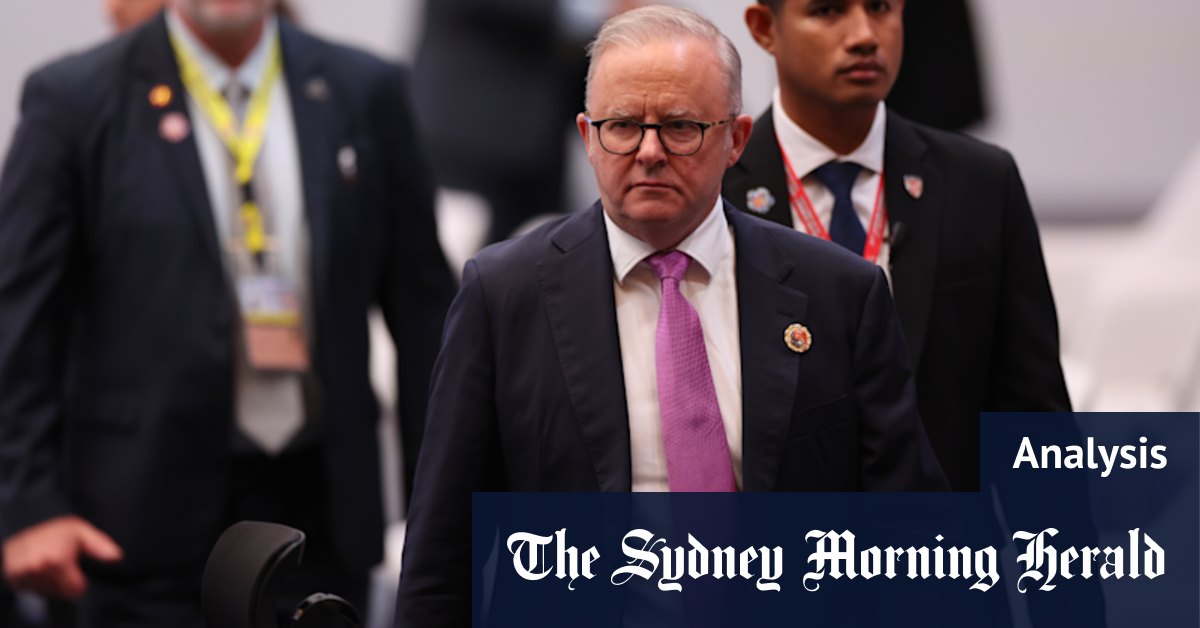
The Malaysian leader and his retinue of bodyguards have been a regular sight dashing around the corridors of the central business district convention centre: one minute on the in-house televisions welcoming US President Donald Trump at the airport, the next giving opening remarks for any one of innumerable forums in the city.
ASEAN’s credibility is denuded by the reality that its structure makes it difficult to get things done. For any decision to be made, every disparate member state must agree. Also, member states cannot be seen to be interfering with another member’s internal affairs. Big change, therefore, is hard.
The South China Sea remains an unresolved point of contention. And the Myanmar civil war, the bloc’s greatest crisis but forgotten by the West, rages on, with thousands of civilians already dead and locked up, and millions displaced. ASEAN’s so-called Five-Point Consensus, which the military junta disingenuously signed up to, has been completely ineffective.

Anthony Albanese with Thai Prime Minister Anutin Charnvirakul, left, on Monday.Credit: AP
The group is now fragmenting on preferred approaches, with nations like Thailand advocating for more direct dealing with the junta, while others insist on big tent discussions.
Anwar can at least boast that his chairmanship led to the accession of the Timor-Leste as the 11th member of the bloc. This summit also provided a forum for an enhanced peace deal between enemies Thailand and Cambodia, even if it was stage-managed for Trump’s campaign to win next year’s Nobel Peace Prize.
Albanese’s two-and-a-bit days in Kuala Lumpur netted formal meetings with the leaders of Thailand, Vietnam, Malaysia, the Philippines and Japan, whose new prime minister, Sanae Takaichi, was attending her first official summit.
Loading
Albanese was also pictured on Instagram with Cambodia’s Hun Manet.
“For more than 70 years, we’ve been working with Cambodia to make a difference. From health to education, to promoting and protecting all human rights,” Albanese’s Instagram post read. “Today I discussed with the Prime Minister Hun Manet how we could build on this work.”
But Albanese’s words, and simple encounter with Manet, the son of Hun Sen, will have undoubtedly upset members of the Australian Cambodian community, some of whom fled their homeland fearing for their lives.
With a long history of getting rich off corruption and political violence, elites within the ruling Cambodian People’s Party have in more recent years turned their attention to the extraordinarily lucrative industry of global scams.
Loading
One US-funded research report this year noted how Cambodia’s scam economy was worth upwards of $20 billion a year. For comparison, the country’s largest legal industry, textiles, had gross export revenues of about $14 billion in 2022, according to author Jacob Sims.
The Khmer Times reported after the meeting that Albanese had “praised Cambodia’s efforts to combat cybercrime and online scams, noting that these challenges affect all countries”.
Now, his cup full, Albanese moves on to South Korea. The big show at APEC: Trump and Chinese leader Xi Jinping.
