


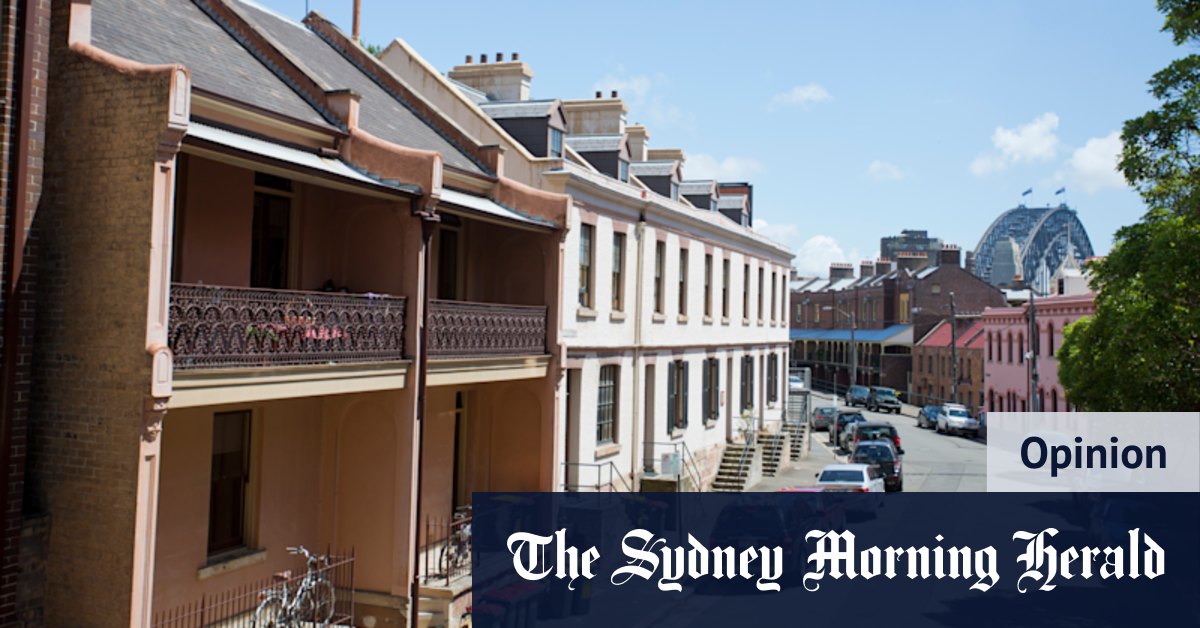
When I was 12, my mother sent me to high school in The Rocks. It was the early 80s and I was following in the footsteps of my sister, who had just completed Year 10. Although we lived in south-west Sydney, my mother thought going to school in the city would broaden our horizons, helping us to understand there was a world beyond our comfortable suburban life. It managed that – and more.
St Patrick’s Girls’ High was behind St Patrick’s Church in Grosvenor Street. A small, low-fee paying school for roughly 300 students, it serviced families all over the city and inner suburbs, new migrants’ daughters, factory workers’ daughters, a ragtag group from the suburbs, and a sizeable contingent from social housing in Millers Point and Woolloomooloo. Our partner school (and Anthony Albanese’s alma mater) was St Mary’s Cathedral College, which, well before its glow-up in the ’90s, welcomed a similar demographic of working-class and middle-class parishioners and their sons.

Homes in The Rocks and Miller’s Point may have been gentrified and the neighbourhood has lost some of its vibrancy.
Ruth Park’s excellent Playing Beatie Bow was on the curriculum for Year 8. A time-travelling novel, it captured The Rocks in the present day (again, the ’80s – what a time to be alive) and 1873, when the area was at its zenith. The protagonist, Abigail Kirk, who lives in The Rocks, accidentally slips back in time, when the streets were alive with commercial and residential activity. A centre of mercantile activity, the area was interspersed with workers’ cottages and grander homes, all with direct access to the harbour.
How things have changed. News that Millers Point child care centre is due to close at the end of the year is yet another signal that money has squeezed the life out of a part of Sydney that was once thriving.
Loading
The first sign for me was the closure of my old school. Despite their best efforts, the Sisters of Mercy nuns were unsuccessful in their efforts to stop it so, after more than a century of teaching, it closed its doors in the early ’90s, with the convent following suit soon after. While St Mary’s Cathedral College was upgraded, the closure meant there was no equivalent for girls’ high school education for those on more modest incomes in the city (St Mary’s is now co-ed). Indeed, the last time I checked, there was a prestige real estate agency on the site of my old school.
Still, it gave me comfort at the time to know that the social housing legacy remained.
I always thought it spoke well of Sydney that some of the best views in the city belonged to the least wealthy. For a glimpse of the way things once were, Ruth Park’s Sydney, first published in 1973, gives an excellent account of the area, peppered with conversations with locals and committing to history their memories of community events ranging from street brawls to bonfire nights.
After claims by the state government that the homes they lived in would cost up to four times the price to repair because of their heritage status, news came in 2014 that the properties would be sold off. At the time, it was argued that they were unsafe in particular for elderly tenants, who were relocated to newer, more suitable accommodation. Even the longstanding campaign to save the Sirius public housing block was, in the end, unsuccessful.
