


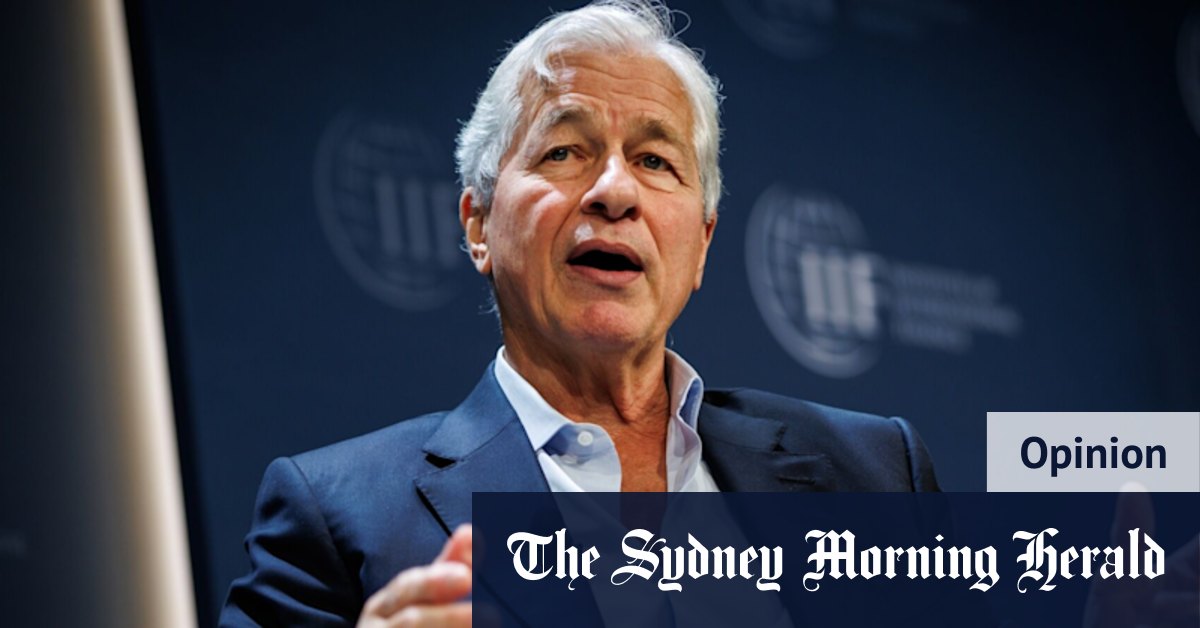
Dimon’s comments, however, resonated because they speak to long-standing concerns about the way the global financial system has developed since the 2008-09 financial crisis.
Before that crisis, the financial system was split fairly evenly between banks and non-banks. Since then, while the share of the system held by banks has, according to the Bank for International Settlements, grown from 164 per cent of global GDP to 177 per cent, that of the non-banks has exploded from 167 per cent to 224 per cent.
Loading
With the banks corralled by increased capital and liquidity requirements, the system is now dominated by asset managers, private equity firms, hedge funds, insurers, private credit providers and other non-bank financiers that are far less regulated and whose activities aren’t anywhere near as transparent.
While banks might originate and arrange loans, they now increasingly distribute the debt to non-bank institutions and managed funds rather that hold capital-intensive assets on their own balance sheets.
In many respects, by distributing risk and diversifying exposures to it, the post-GFC architecture of the system ought to reduce systemic risk. The fear is that the concentrations of risk have just been moved elsewhere and contagion within a particular non-bank sector might still be a threat to overall financial stability.
There’s also a concern, evident in the recent corporate failures and the allegations of fraudulent activity, that the responsibility and accountability for assessing credit risks have been diluted by the changes in the way loans are now made.

Markets have become concerned about the risks from shadow banking to the financial system.Credit: Bloomberg
Banks are less concerned about credit quality when they are passing off the risks to a range of third parties.
Non-banks don’t necessarily have the risk-evaluation experience or systems to screen credit risks and, in any case, when holding just a slice of a loan within a diversified portfolio of sliced and diced loans funded by other people’s money, they have less motivation to focus on the risk of the individual tranches of loans someone else has arranged and sold down.
In a post-GFC, post-pandemic environment of loose monetary policies and easy access to cheap money, credit standards and the pricing of risk have become less top-of-mind. Spreads in the junk bonds market have been compressed to the point where there isn’t that much of a distinction between creditworthy borrowers and the riskiest.
Financings have also become more complex. First Brands tapped multiple funding markets, from banks, private credit, the leveraged loan and collateralised debt markets and receivables financing.
Loading
With too much money from too many sources chasing a finite number of opportunities, it shouldn’t be surprising that underwriting standards are being questioned within a system where there’s no compelling incentive to devote the resources to scrutinising credit quality, when portfolio approaches to risk management with non-bank funds make individual credit risks immaterial.
Easy money and competition make for an uneasy and potentially combustible mix, particularly if risks are rather than being concentrated in individual banks or non-banks, concentrated within a sector. That’s why there has been increased discussion about the rate of growth in the private credit sector, the $US2 trillion market for collateralised loan obligations and other forms of leveraged lending.
Bank “runs” may have been made less likely by the tougher regulatory regime introduced after the financial crisis – although the Trump administration is trying to roll back some of that regulation in the US – but it is conceivable that there could be a contagion-driven a run on non-bank funds if enough “cockroaches” emerge from within the shadow banking sector – contagion that could have spillover effects for the banking system.
While the US Federal Reserve Board has started to cut interest rates, it has also been unwinding the splurges of cheap credit it injected into the system in the aftermath of the financial crisis and, again, in response to the pandemic. Instead of quantitative easing, the system is now experiencing quantitative tightening.
Loading
It is instructive that banks were accessing the Fed’s short-term lending facility last week, an indication of liquidity pressures, given that they can normally borrow more cheaply in the market. The era of excess credit might be finally nearing its end.
The recent spate of corporate collapses – and the absence of lenders’ due diligence that they suggest – may be a sign that the non-bank debt market has over-heated and that companies were given credit that they should never have received on terms that didn’t reflect the risk.
There’s always a concern about financial bubbles. There may be a bubble in private debt markets. There’s probably one in AI-related stocks and investment, and that has been driving what may be a bubble in the overall sharemarket.
It’s impossible to say how threatening these developments might be. There’s too little transparency in the shadow banking sector and too little understanding of the potential returns from the massive investments in AI and the data centres to support the technology to come to any conclusions.
History suggests, however, that when too much money is lent to companies with poor creditworthiness, or too much money is invested too quickly in particular sectors, it rarely ends well.
The Business Briefing newsletter delivers major stories, exclusive coverage and expert opinion. Sign up to get it every weekday morning.
