


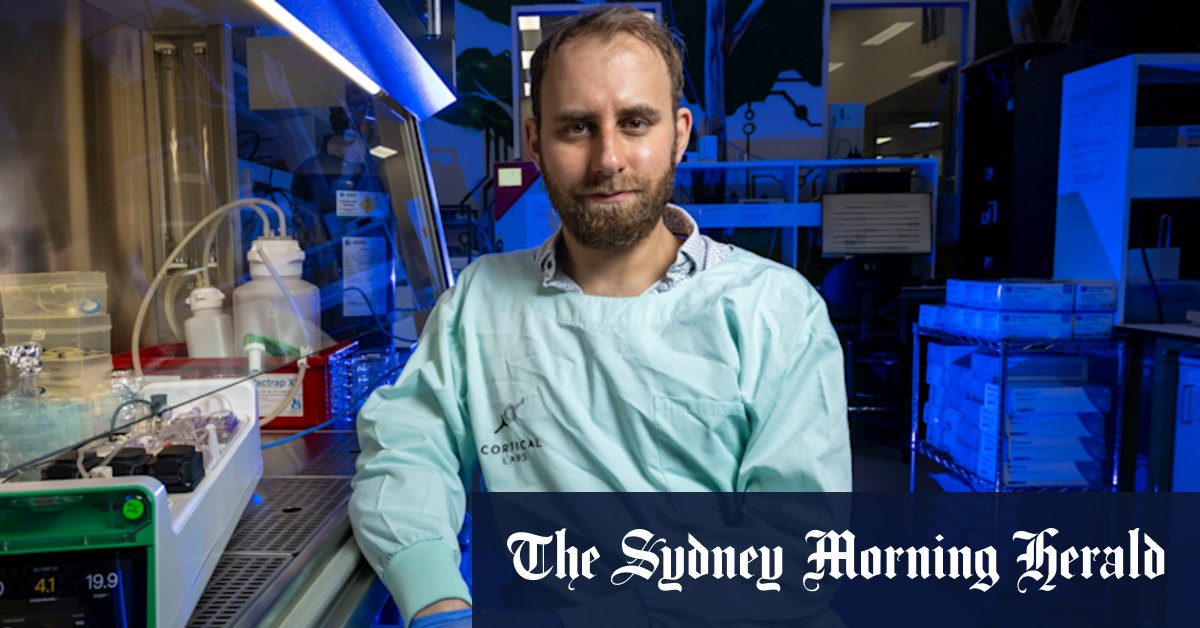
A researcher pulls up a real-time feed from the neurons. Spikes of electrical activity fill the screen. “These are very talkative,” says Kagan, Cortical’s chief scientific officer, watching his creation.
A couple of CL1 units have been sold to a cryptocurrency company. Other customers want to teach the neurons to control robots. Some people want to try to make music or art with the neurons. Some undergraduates have been trying to get the brains to play the video game Doom.
Cortical has built a software layer allowing developers to write Python code directly to the neurons. “If we could figure out their programming language, we could use them in a way that isn’t physiological but could be really powerful,” says Kagan. “How do you take the material of biology and use it for computation?”
This is where the handwriting training comes in. The team are feeding in picture after picture of handwritten 7s and 8s, trying to get the neurons to tell them apart. “They are pretty good at that,” says Kagan. If the networks can learn to understand even basic language, you could prompt them with much more sophisticated data, such as questions, rather than just electrical impulses.

The CL1s hold the neural matrix and a life-support system.Credit: Wayne Taylor
Basic research remains the team’s focus. Unlike other start-ups, which jealously guard their products, Cortical have published more than a dozen basic science papers in the past three years.
“The key thing is to understand what underpins all of it. We could do another Pong, we could make the games fancier. But if we don’t understand the input-output relationship, it’s just gimmicks for the sake of gimmicks,” says Kagan. “That would get media attention. But it wouldn’t advance the field.”
One AI researcher – speaking anonymously to share a critique – described playing Pong as “a fancy trick that does not lead to much”.
Artificial intelligence works when you have very large numbers of artificial neurons linked together. But human neurons would struggle to achieve that scale inside a computer, the researcher said. “It’s not going to be more robust than silicon. And it’s going to be way more expensive.”
Cortical has heard this criticism, but Kagan says his wetware is evolving to better mimic the brain.
Modern AIs are built on artificial neural nets: matrices of artificial neurons, which gradually learn to distinguish cats from not-cats.
An artificial neuron is much more powerful than a human neuron, computes faster and sends signals further. Yet our brains can do things – recognise faces, for example – far more efficiently than computers, and we don’t have as much difficulty spelling the word strawberry.
Why? Structure.
Our brains have evolved specialised structures made up of different brain cells that can perform specialised tasks really efficiently. That’s the direction Cortical is trying to head.
“This is the next step towards engineering intelligent biological devices,” says Kagan. They have already coaxed the neurons into forming small differentiated networks, and are now working on incorporating multiple different types of brain cell into their computers. “They seem, based on early data, to be doing things much more powerfully.”

Brett Kagan: “How do you take the material of biology and use it for computation?”Credit: Wayne Taylor
Cortical has been collaborating with Monash University’s associate professor Adeel Razi on a defence department-funded project to test another unique feature of human neurons: they generalise. AI can develop superhuman skills on one task but can’t generalise those into other tasks. “We can use our skills to learn new skills,” says Razi.
In the short term, the machines are most useful for basic brain-cell research. How do individual neurons work? How do they communicate? How do distributed bursts of electrical activity become thoughts?
Then there’s drug-testing. The neurons can be manipulated to mimic various diseases, then exposed to drug candidates. In a paper published this year in Communications Biology, Cortical’s researchers manipulated neurons to mimic a disorder linked to epilepsy, and then showed that an anti-seizure drug could improve their performance.
The team has swelled to 25 people, plus three people in Malaysia, where the computers are manufactured. They have manufactured 150 units, but are still waiting for the rest of them to arrive.
They raised $10.6 million in a 2023 capital raising led by Horizons Ventures – an early investor in Siri – plus a $250,000 grant from the federal government.
They are clear that it is not enough. “We’re definitely in a race. There are groups in China with huge government support. There are groups in the US with considerable industry support,” says Kagan. “We love Melbourne, we love Australia. The reality is, unless there is some movement to show government loves us back, you can only go so far.”
The Examine newsletter explains and analyses science with a rigorous focus on the evidence. Sign up to get it each week.
