



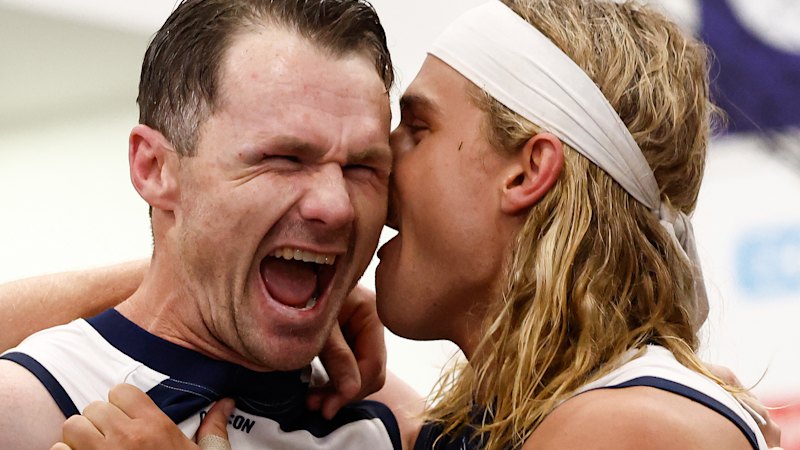
But the story wasn’t merely the quality and scale of Dangerfield’s work. It was when and where he did it.
He booted the crucial first goal (from a free kick) for the Cats as they reeled from the gold-and-brown onslaught, and then, in the second quarter, the captain led the charge that saw Geelong wipe off that deficit to lead by a point, as Bailey Smith, Tom Atkins, Mark Blicavs and their other nuclear weapon, Jeremy Cameron, followed his lead.
Hawthorn wilted in the face of this counter-offensive.
The Cats cleared out in that third quarter, when the momentum from the midfield became like a boulder hurtling downhill. Of their seven goals in that term, five came from stoppages – a measure of how Smith, Dangerfield and Atkins had routed the Hawks.
Loading
For Hawthorn, this final reiterated what they had known – that they were one gun midfielder short even with Will Day, and two shy of premiership-calibre when Day is grounded. The pursuit of Zach Merrett is based on that bottom line.
“I’m really proud of the way our guys rallied after an imperfect start,” Dangerfield told this masthead.
“They [Hawthorn] were playing well, pressuring well – but a bit of it was self-inflicted, like we didn’t use the ball particularly well. We got that right in the second, [and] cleaned up our contest a bit.”
The concussion of Stewart was other major subplot from this final; when it transpired – coupled with Henry’s ankle (which seemed worse when it happened) – one wondered whether the Cats would be able to cover the loss.
Loading
By game’s end, the narrative had shifted to Stewart’s loss – no one who watched this final would doubt that Geelong could cover for Stewart next weekend.
“It’s still very raw,” said Dangerfield of his friend Stewart’s concussion.
“Because we set ourselves … there’s individual goals, and there’s collective goals. And he is such an important part of our team, and also a friend of mine.
“It’s a tough thing to swallow, for sure.”
Dangerfield’s finals record is imposing, having been close to the Norm Smith Medal in the 2022 grand final massacre of the Swans. In Richmond’s zenith, Dusty Martin had held the title of finals performer nonpareil; on this occasion – which drew more than 99,000 fans – “Danger” produced what might have been his finest hour-and-a-half.
I asked him to assess his performance, where it stood in his long career.
“To be honest, it’s just the next one,” he said. “When you get to my age, all that matters is the next one. And if you look too far ahead or reflective, then you forget to live in the moment.
“So, I had to catch myself this morning, I was really nervous, getting up, [I] marched off the kids to school and sort of sitting at home, I’m like, ‘I’m a little nervous here’, and I had to set myself, just to a point of view, ‘Mate, enjoy the moment.’ And you don’t know when the next opportunity is going to be.
“It’s a beautiful game, it’s a bloody hard game, and you never know when it’s going to be up.
“That was sort of a nice little self-leveller this morning, you go, ‘Mate, don’t take yourself too seriously.’
“So tonight was about taking a swing, and you don’t kid yourself – it’s not like you play with nothing to lose.”
There was so much to lose, of course. But the 35-year-old number 35 refused to let his team succumb. He didn’t merely live in the moment.
He owned them.
Keep up to date with the best AFL coverage in the country. Sign up for the Real Footy newsletter.
