


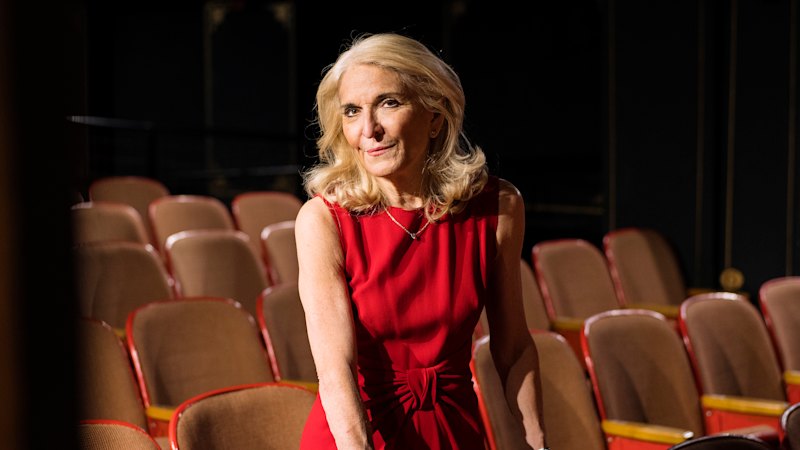






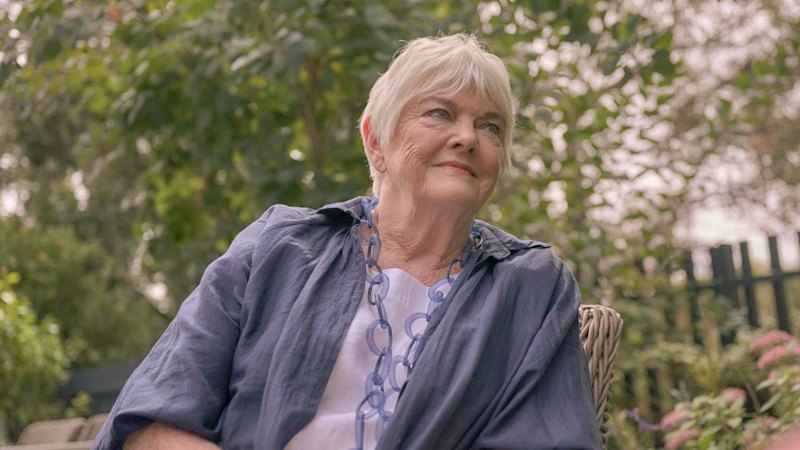
Stephanie Alexander has made me lunch. A leek and gruyère tart. It sits on the pale wooden table in her large garden apartment, looking delicious: rough-textured gold-brown pastry, pale primrose filling, deep caramel edges. Alexander herself, white-shirted, white-haired, 85 years old, is standing behind the kitchen bench, holding a bottle of wine. “Will you?” she asks.
It’s lunchtime; it’s a weekday; I’m working. “I will if you will,” I say.
Thanks to the mountain of media chronicling her influence on Australian food over the past 60 years, it’s clear that Stephanie Alexander is a person capable of saying no. But it’s also clear how much she loves a beautiful meal and everything that accompanies it. She is Australia’s most revered chef-author, and her magnum opus, The Cook’s Companion, is in more than one in 20 households in this country. It proclaims her fundamental message: that good food gives us not only physical, but spiritual sustenance. Eating well and taking pleasure in it, says Alexander, is crucial to our “personal independence and happiness”.
She still practises what she preaches. Every night she’s at home, even if she’s on her own, she sits down to a carefully laid table – “with a fabric napkin, never paper – never”, a delicious homemade meal (even if it’s eggs on toast) and a generous glass of wine.
All of which means that I fancy my chances of a crisp white with lunch. And Stephanie Alexander does not disappoint. Face deadpan, small twinkle in her very bright blue eyes, she unscrews the cap on the bottle.
Stephanie Alexander is not just a cookbook writer. As a professional chef, her Melbourne restaurant, Stephanie’s, spent two decades at the forefront of Australian and international culinary excellence. And as an educator, her Kitchen Garden Foundation, which operates in 1650 primary schools around the country, expresses her conviction that understanding food – how to grow, cook and eat it – should be part of fundamental learning.
Nonetheless, it’s as an author that most of us know her: the author of Australia’s most famous cookbook. The Cook’s Companion celebrates its 30th anniversary this year. It’s a unique book: more than 1100 pages long; 1000-plus recipes; organised by ingredient. Almost every page includes idiosyncratic side notes. “Emu eggs can be used for baking,” she writes in “Eggs”. “In volume, 1 emu egg is the equivalent of 6-10 hen eggs.” Zero pages include recipe photographs – a deliberate decision so as not to demoralise readers if their dish doesn’t match the picture. The sole image in “Eggs” is the back end of a hen.
For such a big, expensive book (the latest edition, which has about 100 new recipes, weighs 2.8 kilograms and retails for $130), The Cook’s Companion has been extraordinarily successful, selling more than half a million copies across three generations. And because it contains not only recipes, but also enormous volumes of information and reflection on how food works – flavour pairings, seasonality, even basic chemistry – many experts actually believe it’s helped transform Australian cooking en masse. In Neil Perry’s opinion, The Cook’s Companion “has helped shape a nation of quality home cooks”. Masterchef may have taught us about “plating up”, but it’s Stephanie and her big orange book that have showed us how to get something delicious on that plate.


There’s one other thing about The Cook’s Companion. It is, essentially, a pre-digital book. It was designed for people without access to online Fahrenheit- Celsius conversion; who couldn’t ask Siri what flavours go with beetroot (kangaroo, among 34 other things); who were unable to download an instructional video about boning a chicken (with a small sharp knife, carefully.)
This means that now, despite the anniversary fanfare and its extraordinary history, the new edition actually faces an existential crisis. Does anyone
actually need it? Isn’t everything it contains available elsewhere, in easier, more user-friendly forms? Take chicken-boning. I’ve read The Cook’s Companion; I’ve watched a YouYube video. I hate to say it, but video wins.
The Cook’s Companion, however, has a secret ingredient. It may no longer be Australia’s sole encyclopaedic source for choosing, handling, cooking and communing with food. But it’s the only one created by Stephanie Alexander. And that, it turns out, really matters.
If you were going to build a food guru from scratch, you could do worse than follow the blueprint of Stephanie Ann Alexander, born November 13, 1940. First, you need the right kind of environment: a semi-rural home on Victoria’s Mornington Peninsula, with a big vegetable garden, chickens and sources of edible wildlife (rabbits, eels, fish) nearby. Second, you need a significant early influence: maybe a loving, exacting mother who was herself a highly accomplished, passionate cook. Third, you need profound experiences: perhaps a seminal trip to Europe, especially France, in early adulthood, to provide examples of food as both art and craft; intellectual challenge and emotional reward.
‘If somebody asks me a question, I can’t see the point of telling them a lie or avoiding it.’
Stephanie Alexander
Alexander had all these things, filtered through the layers of her particular personality. “She’s very driven,” says her older daughter, Lisa Montague, a PR and media manager. “She needs projects. She loves travel; she remembers practically everything; her mind never stops.” The pair recently went on holiday in Bali, she recalls, and though they were in separate villas, one night Lisa heard her mother shouting in her sleep: “Decisions, decisions, decisions!”
Alexander herself admits she’s an anxious person, shy – particularly in crowds; an obsessive list-maker who drives herself too hard. She once found an old notebook in which she’d written, “At least once a day I feel utter despair at the enormity of the task and the impossibility of achieving perfection.”
“I still have that feeling,” she says. “Some days I wake up feeling just overwhelmed. But I also know that as soon as I get up, it goes. It’s a kind of fear of facing the day. I wish I didn’t have it, but I know it goes as soon as I get up. I don’t carry it through to breakfast.”


It’s an unexpected quality of Alexander that she talks like this. She has a no-nonsense, practical manner, so it’s odd, but excellent, to hear her speak openly about failure and vulnerability. “I suppose I feel the truth is the truth,” she says, cutting two generous portions of tart. “If somebody asks me a question, I can’t see the point telling them a lie or avoiding it.”
She’s had two marriages, both undertaken with love and energy, both ending in divorce. She has two daughters whom she adores, but about whose childhoods she still carries guilt. She’s had two restaurants which brought her great joy and success, but which were also sources of worry and financial near-disaster.
She’s had therapy over the years, she admits matter-of-factly, and “one of the things they talk about a lot is the inner critic. And I must say, I think the inner critic never dies. Sometimes I can give myself a little bit of self-talk about ‘Come on, it’s not that bad’ or ‘It’s not that important’. But I think I’m still pretty hard on myself.”
In this context, The Cook’s Companion is, and always has been, an unequivocal pleasure. “For me, cooking is like falling off a log,” she says. “I can make a meal out of something, anything, and it will be lovely. And it distresses me that some people find it so incredibly anxiety-making. I want to show people that cooking – successful, delicious cooking – does not have to be stressful and horrible.”
She pauses, and I seize the moment to tell her, mouth full, how extremely good the tart is. She smiles – a small smile, genuine but unsurprised. “Cooking a meal is a lovely way of showing – well – showing positive feelings towards other people, but also getting them back.” She smiles more broadly. “When you cook for people, you gather back a lot of love.”
Alexander returned from her first European trip of two years in 1965 with her first husband, Jamaican-born Rupert Montague. In 1966, they opened a tiny cafe called Jamaica House, in Lygon Street Carlton. It was a labour of love and idealism that swiftly descended into something that sounds like the plotline of an especially harrowing domestic drama. Alexander did all the cooking with two burners and one tiny fryer, while Montague worked front of house and also continued his full-time job as an industrial glassblower. Their three-week-old “darling baby” Lisa was wedged into a tiny room between the dining room and kitchen.
For months, nobody slept, nobody ate, everybody wept. Alexander had dermatitis all over her hands and her milk dried up. It was, she wrote in her 2012 memoir A Cook’s Life, “appalling”. She was either working or utterly exhausted: she feels an enduring guilt for letting others care for Lisa some days so she could rest, though it’s hard to see how else she could have functioned.
Two torrid years after Jamaica House opened, Alexander and Monty separated, and she severed her connections with the business. “As Mum puts it, the marriage just fell over,” says Lisa Montague. “And we all just tumbled down into this sorrowful, difficult time.” In the end, this grief played out many years later between mother and daughter, creating “friction and a lot of sadness”. Their relationship survived, Montague says, partly because she and Alexander are both willing “to tear things apart and get to the nut of the issue. One of the wonderful things about our relationship is that we’re good sounding boards for each other.”

As well as being personally devastating, professionally Jamaica House left Alexander “shuddering” at the thought of another restaurant. But she lost none of her passion for food itself. For the next eight years, working as a high-school librarian – she’d completed her bachelor of arts in 1966 – she hosted dinner parties, held informal cooking lessons, and saved up to eat out and travel.
In 1976, having admitted to herself she couldn’t resist the lure of professional hospitality, she opened Stephanie’s Restaurant on Brunswick Street, Fitzroy with her second husband, barrister Maurice Alexander. It was a hit from the start. Alexander made her own bread, stocks, petits fours, puff pastry, ice-cream and sorbet. She infused custards with rose-scented geranium, enhanced fish with lemon verbena, sprinkled soup with dried marigold petals. Once a week, her mother filled vases with fresh herbs and flowers.
As a champion of local, sustainable, seasonal cooking long before such words were fashionable, Alexander mentored many future famous chefs. She employed Tony Bilson (La Pomme d’Or, Berowra Waters Inn) when he was still a garden labourer; she gave Greek immigrant electrician Janni Kyritsis (Bennelong, MG Garage) a job in her kitchen at Stephanie’s; a youthful Damien Pignolet (Claude’s, Bistro Moncur) came to eat and learn in her dining room every week.
In 1980, the family – including daughter Holly, born in 1974 – moved into a grand 19th-century Italianate mansion in Hawthorn, with room to live upstairs and an expanded Stephanie’s down below. It was in this second incarnation, with Arthur Streetons and Norman Lindsays on the walls and chandeliers hanging from the ceiling, that Stephanie’s and Alexander both became Australian icons. In the kitchen, Annie Smithers (Bistrot, Du Fermier) looked after the homegrown snails, Neil Perry (Rockpool, Rockpool Bar & Grill, Margaret) washed – and dried – the lettuce (a detail he has, he says, never forgotten). Maggie Beer was invited to spend a week observing the running of the kitchen. “I was just absolutely in awe of her,” she recalls. “You could say ‘frightened’. Also humbled at her generosity. We didn’t have the money to go to Europe and see what was happening there. She had French chefs in the kitchen; there was a European sensibility, but it was all her. It was so inspiring.”
During these years, Alexander was part of an international cooking revolution. In the late 1980s and ’90s, for the first time, chefs were becoming as famous as rock stars, restaurants were transforming into international tourist destinations, and glamorous cooking content began to fill screens, magazines and newspaper columns. It was on Alexander’s watch that modern food culture – today a multibillion-dollar global business – was born.
“Being in the kitchen itself was wonderful,” she recalls of this time. “I was always pleased to go to work. The adrenaline of service was like nothing else; it was this supportive place filled with wonderful people, with lovely ingredients and a nice sharp knife, where I could lose my anxiety about all the other things in my life that weren’t going very well.”
Things like her second marriage. Ironically, the tensions between her and Maurice often revealed themselves in Alexander’s most sacred space – around the family dinner table. She is predictably hard on herself about this. “I am very aware that both my daughters had difficult times around the table, despite the fact that I go on about how important it is,” she says frankly. “The marriage was terrible. There was constant hostility, and you either expressed it in an argument or you had a silent meal. So the kids pissed off as soon as they could, and who could blame them? Fortunately, we are very close now, but I don’t know whether it’s ever compensated.”
In fact, both her daughters are understanding about this period. Holly Alexander is a scriptwriter, editor and mother of Alexander’s beloved granddaughter Juliet. “Things around the table were often quite tense,” she says, “but for me, I think it was two-fold. There was obviously a lot of stuff going on with Mum and Dad, but I was also quite a fussy eater as a child, so that, I think was a bit of a source of conflict. And actually, she was amazingly tolerant of it. She didn’t want food to become a battle, so she would just say things like, ‘Just try a little bit. Just try that flavour. Do you notice how it’s crunchy and crispy and how it goes well with that other thing?’ ”
“I was a bit of a surly teenager,” recalls Montague in turn, “so I think I was pretty preoccupied with my own life. I do remember Holly and I sitting at the top of the stairs, looking down at the front door of Stephanie’s and watching people like Mick Jagger and Jerry Hall arrive. Mum was very caring and loving, but she was a restaurateur and a mother, and there was no manual and no help. So sometimes the mothering took a direct hit. As a kid, you just find your own way to deal with it.”
‘There were all these people [who] didn’t feel relaxed cooking. I wanted to talk to those people.’
Stephanie Alexander
One of Alexander’s own ways was to write. “She is sometimes more comfortable writing than talking about things that are important,” says Beer. “I think she expresses herself emotionally through writing.” In 1985, her first book, Stephanie’s Menus for Food Lovers, was published. The response was enthusiastic, and more books followed. By 1992, she was contemplating an “alphabetical ingredient book”.
“I began to realise that there were all these people – including my own friends – who had grown up, married, had children and still didn’t feel relaxed cooking,” she recalls. “I wanted to talk to those people. I wanted them to feel they could trust me: ‘Hold my hand, and I will take you there.’ That was the beginning.”
The beginning of something that swiftly became bigger than Ben Hur. “By the time she got to the letter C, the manuscript already filled half a photocopy box,” says publisher Julie Gibbs. “I remember thinking, ‘Holy moly!’ But somehow I just said, ‘Keep going, keep going.’ And she was extraordinary. She was still cooking in the restaurant; she had a family. She would finish work at midnight and get up at 4am to write. She was absolutely dogged.”
As the manuscript grew, Gibbs became more and more convinced of its value, and more and more worried about whether it would ever get published at all. “There was a famous meeting at Penguin on Tuesday mornings where as a publisher, you had to convince sales and marketing to back your projects,” she recalls. “I remember going in to tell them about The Cook’s Companion. There were a lot of men wearing suits, and they just folded their arms and sat there looking at me like, ‘You have got to be joking.’ And I had to grip the table with my white knuckles and just keep talking. I still feel sick even thinking about it.”


But Gibbs got there – and so did Alexander. The Cook’s Companion was published in 1996, with a burnished orange cover, gold writing and a small central picture of an apple, beans and a chicken. And the world changed.
After the tart, Alexander puts a small bowl of dressed salad leaves – the pale, crunchy hearts of baby cos – on the table between us. Serving herself after me, she glances around. “The last few years, being here, have been the most peaceful I’ve ever felt,” she says suddenly. “I really do say to myself, ‘I’m very fortunate to have been able to offer all this to myself.’ And it’s all thanks to The Cook’s Companion.”
At the end of the ’80s and into the ’90s, costly renovations at Stephanie’s, plus the recession, plus buying Maurice out when the marriage ended put Alexander in a perilous financial position. In the mid-’90s, she tried to sell Stephanie’s, without success. And then, the publishing miracle. Royalties from The Cook’s Companion enabled her to close the restaurant with honour, leaving no debts unpaid. Suddenly, she was in her late 50s, with two grown children and financial security. She was free.
Another person might have elected to step back and take it easy. Not Alexander. She established the Kitchen Garden Foundation in 2004 with one garden at one school, Collingwood College. Today, it reaches 40,000 Australian school students each week. To Alexander, what the kids really love is “not just the gardening or cooking, but being together around a table. They’ve put effort into setting the table, gathered a few herbs into a jar, even lit candles.” She laughs. “They just beam. There’s never any bad
behaviour – never.”
Of course, it’s not always perfect. CEO Robb Rees recalls a recent call from a teacher who said, “‘I was all set to do a recipe with the kids using cherry tomatoes, and the mice have eaten the entire crop. Now what do I do?’ So the team said, ‘Well, you teach them about mice.’ ”
The intrusion of real, rodent-riddled life does not intimidate Alexander. “Lots of people care about kids eating better, about healthy food and local produce,” says Rees. “And some people will even get involved with supporting those things. But virtually no one maintains support beyond a couple of years. Stephanie’s done 20-plus. Her passion is absolutely genuine.”
She is still pivotal to the foundation. Last year, it received a “transformative” multimillion-dollar donation from philanthropist Annie Cannon-Brookes, which will span five years and establish a significant food education hub for primary-aged schoolchildren in NSW’s Southern Highlands. “When you meet Stephanie, you immediately see how deeply she believes in her mission,” says Cannon-Brookes. “It has been a pleasure to help continue her legacy.”
Once we’ve finished our wine and our tart and our salad, Alexander leans back in her chair. She’s been explaining what’s growing in her own garden, in Abbotsford on the banks of the Yarra. From her full-length windows, we can see a tangelo, lemon tree, lemon-scented verbena, “one lonely saltbush”, sage, thyme, bay, rosemary and tomatoes. The plants, it must be said, look slightly wizened at the end of a Melbourne summer, and Alexander admits she’s moved into ornamentals – especially crepe myrtles, smoke bush, forest pansy – after rabbits decimated her vegetables.
Glancing back at the table, her eye falls on the new edition of The Cook’s Companion – elegant grey cover, jewel-coloured page-edging, general doorstop appearance. She puts her hand on it for a moment. What does she think of its prospects for success in 2026, I ask. What’s its defence against Insta; its riposte to TikTok?
“I think it’s an extremely good question,” she says levelly. “And I’m not sure that somebody of 85 has an opinion that’s particularly valid. But for myself, I will never stop using paper cookbooks. And yes, it’s true that I look up the internet if I’m unsure about something. And mostly I’m happy with the answer I get. But it doesn’t in any way give me the same pleasure as reading somebody whose words I like and whose experiences I value.”
Nonetheless, the future of books in our digital world does feel perilous, right? ’Well, look at Nagi [Maehashi, RecipeTin Eats founder],” says Alexander’s editor, Caroline Pizzey. “The fact that she’s had two massive hits with her books, after having millions of followers on YouTube, proves that the two forms can co-exist.” Another crucial asset, she adds, is that people really trust Alexander: they know her recipes work. “That can be an issue when an Insta-shiny cook puts pen to paper.”
And actually, while we’re on technology, Alexander does, in fact, have an app, which she produced way back in 2013. “It’s a fantastic tool for when you’re standing in the supermarket aisle wondering what to do for dinner.” says Pizzey. “Penguin wasn’t interested in doing it, so she did it herself, as she would.”
I’ve looked at this app, and it seems excellent, but it’s $19.99 and only for iPhones. And – well – I already have the book. Alexander, for her part, doesn’t even mention it. Instead, she gives The Cook’s Companion a final pat, then lays her hands on the table, spreading them wide, beyond the lovely china plates and colourful fabric napkins and elegant empty wine glasses. “The ultimate aim of everything I’m doing is to pull people onto my team,” she concludes. “And my team are the food lovers, the people who get pleasure from talking, and being with others, and enjoying what they eat and drink.”
Who wouldn’t want to be part of that team?
Read more profiles from Good Weekend:
Get the best of Good Weekend delivered to your inbox every Saturday morning. Sign up for our newsletter.


